

What is agentic tee time booking?
Agentic tee time booking is when an AI assistant finds, compares, and books a tee time on a golfer's behalf instead of the golfer searching and filling out forms. Noteefy Insights tracks 200+ course websites and sees AI-referred visits growing 499% in 2025, off a small base, while direct traffic falls. Dining and hotels already take bookings inside AI assistants, and Jake Gordon and Ross Liggett project agent booking could become a primary way new golfers reach a tee sheet in the second half of 2027. Agents default to the closest, easiest inventory, so courses whose tee sheets are reachable and policy-protected stand to capture those rounds.
The headline: Within the next year, golfers will show up at your course having booked through an AI agent. In many cases, they already are.
This post lays out why: what the data shows, what the rest of hospitality is already doing, and what it means for how golfers will find and book your course. It’s the first piece in a short series; later we’ll cover who owns the golfer in this new world and what operators should do about it.
We’ll be candid: we don’t have every answer. We’re maybe one batter into the first inning of agentic booking, and some weird stuff is happening. But the direction is clear enough that waiting to see how it shakes out is itself a decision. And golf has made that kind of decision before.
The Shift to Agentic Booking Has Already Started
Your next new golfer will be introduced to you by an agent, and that agent will get tee times from whoever makes them easiest to book.
This doesn’t mean robots will book every round. Your Tuesday regular doesn’t need an agent to find you. The shift is about the golfer who has never played your course: the buddy trip, the new resident, the visitor in town for a conference. That golfer is starting to ask an assistant instead of typing into a search box.
Think about the last time you searched Google and got an AI Overview at the top. Did it answer your question? Most of the time, it did. Which means the website that actually held the answer never got your visit. Two years ago, “best golf course in Hilton Head” returned a list of links and the golfer decided. Now the AI decides, and a lot of that traffic never reaches anyone’s website.
Noteefy Insights tracks traffic across more than 200 course websites, and the numbers are hard to ignore:
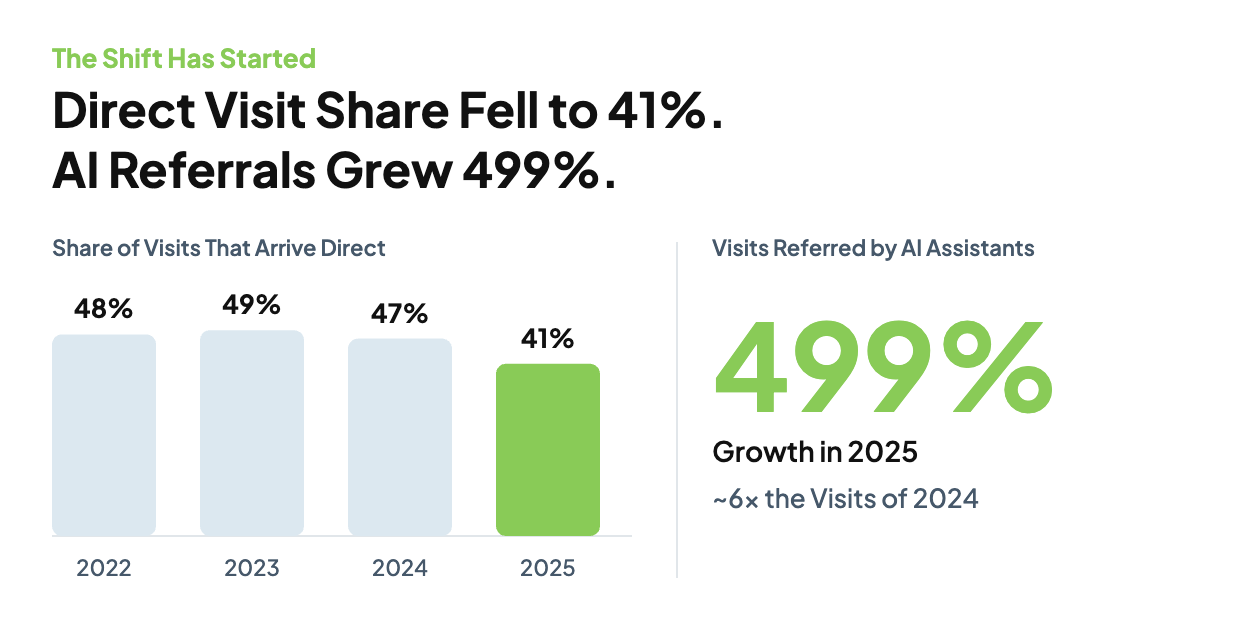
Direct traffic is your relationship traffic: someone typed your name or clicked a bookmark. Rounds weren’t down in 2025; it’s that golfers just stopped arriving at your front door on their own.
To be fair to the numbers, 499% growth on a small base is still a small number. AI is not your biggest channel today, not even close. But it’s the only channel growing like this while direct falls, and it only counts the visits where the assistant bothered to send the golfer to your site.
One of the largest multi-course operators we work with shared their own data with us: about 9.2 million web sessions so far this year. Total web traffic is noisy (was August soft because of weather?), so we won’t overread it. What is completely unambiguous is the AI-referred line. It is climbing every month, with ChatGPT driving most of it. We expect that curve to keep bending upward.
Golfers Are Going from Answers to Recommendations and Booking Action
Nearly every operator we talk to uses an AI assistant at least once a day. Almost none of them has ever used it to actually book something.
That gap is the whole story. We use ChatGPT, Claude, and Gemini to draft emails, prep quarterly reviews, research a trip, and even identify the lizard in the backyard. It’s like a really smart college friend who helps you move faster. But we haven’t yet asked that friend to go do something on our behalf. That’s the next frontier, and it’s arriving fast.
Every major tech company is now building the infrastructure for agents to take action: browse, compare, hold, pay. And the ones with advertising businesses (Google, Meta, OpenAI, which launched ads this year) are highly motivated to keep the customer inside their box all the way through checkout.
What an Agent Booking Looks Like
Here’s a real example.
A golfer types into Muse, Meta’s new AI assistant: “Book me a tee time in Denver for two players on Saturday, nine holes.” Here’s what happens:
- It queries live inventory. The agent finds the course’s booking engine, reads the available times, and comes back with a few options.
- The golfer books and edits in plain language. “Do 4:40 with a cart.” The agent makes the change and shows the total before paying.
- It confirms on the tee sheet. The round lands on the course’s own tee sheet, easy to modify, cancel, or share with playing partners.
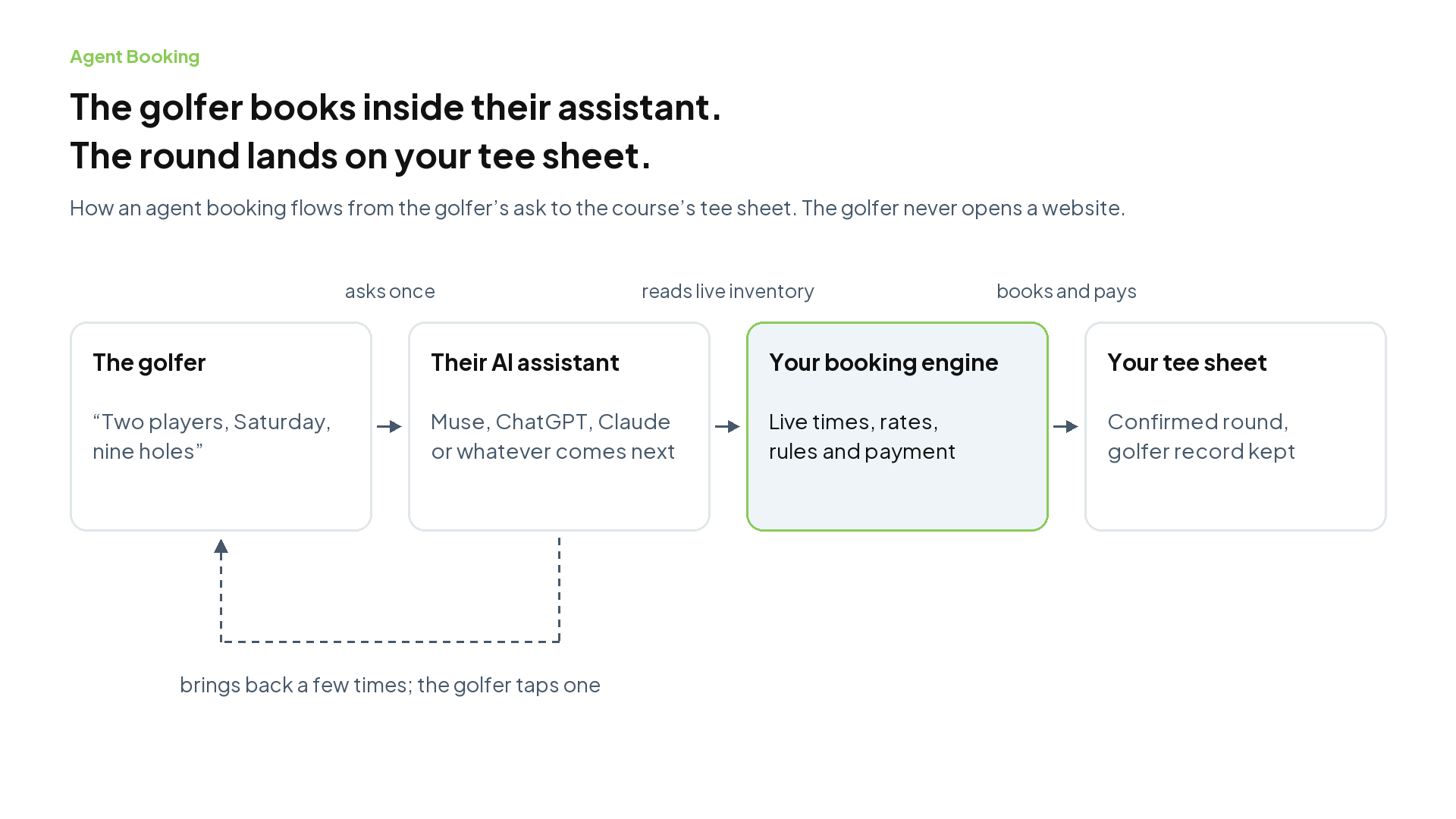
The first time, the agent asks the golfer to create an account and put a card on file. After that, it’s just “Book it.” Confirmed. Done. Want to invite your friends?
Now picture a golfer stuck in a meeting who types under the table: “Book me a tee time in LA this weekend between 8 and 10 for under $100.” The agent scans the inventory, finds a match, and asks if they want it. The golfer never opens a single website.
That’s not five years away. Golfers can already book tee times this way from Muse, ChatGPT, and Claude, at courses whose booking systems let agents in.
Two patterns are already clear:
- Agents default to the closest, easiest inventory: the source nearest the tee sheet with the fewest steps.
- Every booking strengthens the loop. Agents learn a golfer’s habits, so the more they successfully book somewhere, the more they route there first.
Other Industries Are Already There
The best evidence for where golf is headed is that the biggest tech companies are already doing this in parallel industries.
Trip Planning
Try asking Google’s Gemini: “I want a golf trip to Hilton Head, October 8 to 10, three rounds, with flights.” In seconds you get flights, hotels, and golf options in one pane of glass. That’s a query you used to hand to a travel agent. The traveling golfer isn’t going to search “tee times near me.” They’ll ask for a golf weekend, and the agent will fill the itinerary with the courses it can read. The only thing the golfer will say is “Book it.”
Hotels
On August 27, Google AI Mode started booking hotel rooms right inside the chat, with Booking.com, Expedia, Hilton, IHG, Marriott, Wyndham, Choice, Priceline, and Trip.com. The hotel or OTA is the merchant of record. But notice what the hotel receives: four fields. Name, payment, occupancy, property. It doesn’t learn what the traveler asked for, who else they compared, or why the hotel won. Hilton named large language models entering travel booking as a risk in its 10-K this February. Independents are responding with direct feeds, like Lighthouse’s ChatGPT app, which pushes brand-verified rates and sends the guest to the hotel’s own site.
Restaurants
Dining is golf’s closest cousin: a perishable slot, a party size, a time window. In August, ChatGPT began booking tables and joining waitlists in the chat through OpenTable, Resy, and Yelp. Google AI Mode’s restaurant booking went global through OpenTable and SevenRooms in April. And OpenTable reported 17x more seated diners year over year from AI integrations, with AI-referred diners spending about 20% more.
That last point matters. Nobody at OpenAI or Google integrated 50,000 independent restaurants one at a time. They went to the platforms that already bundled the inventory behind one interface. OpenTable is the technology infrastructure working on behalf of the restaurant, and it makes sure that whichever assistant captures the diner’s attention next week, the restaurant’s tables are there.
The lesson for golf: AI platforms won’t integrate thousands of courses one at a time. They’ll connect to whatever systems already hold tee time inventory behind a single interface. Golfers care about your course, not the software underneath it. What matters is whether your tee sheet is reachable when the agent comes looking.
When Do Tee Times Join the List?
Dining took 19 months to go from an agent demo to native booking. Hotels moved even faster.
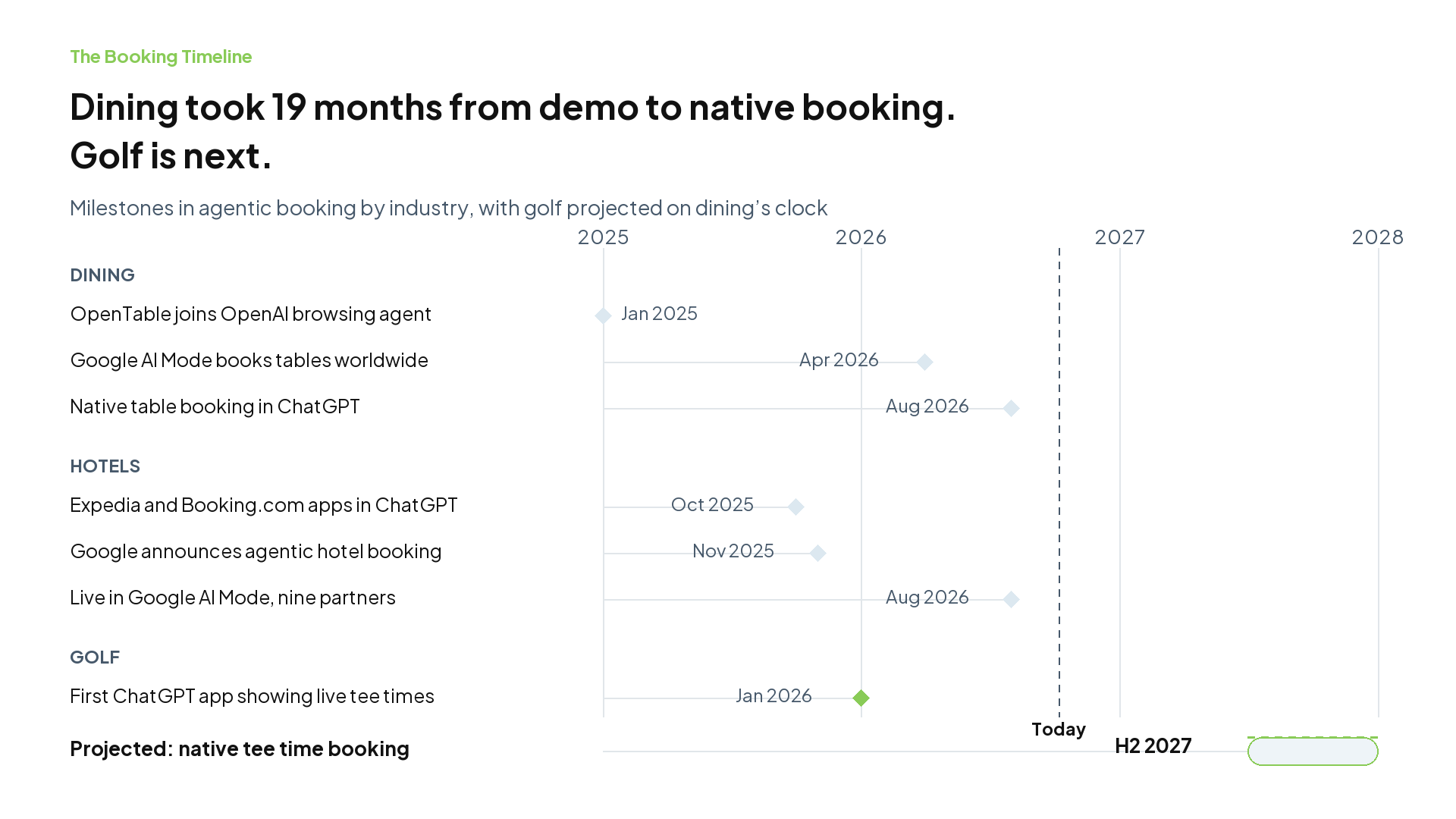
If golf runs on dining’s clock, we’d expect agent booking to become a primary way new golfers land on your tee sheet in the second half of 2027. Here’s what we’re watching for as signals:
- A tee sheet vendor announcing real agent access
- Google or OpenAI naming golf as a booking category
- AI referrals passing 5% of course website traffic
The Trust Gap, and How Fast It Closes
Here’s the part the hype merchants leave out. Travel surveys from Booking.com and Skift show a huge gap between wanting AI’s help and handing it the power to make a decision.
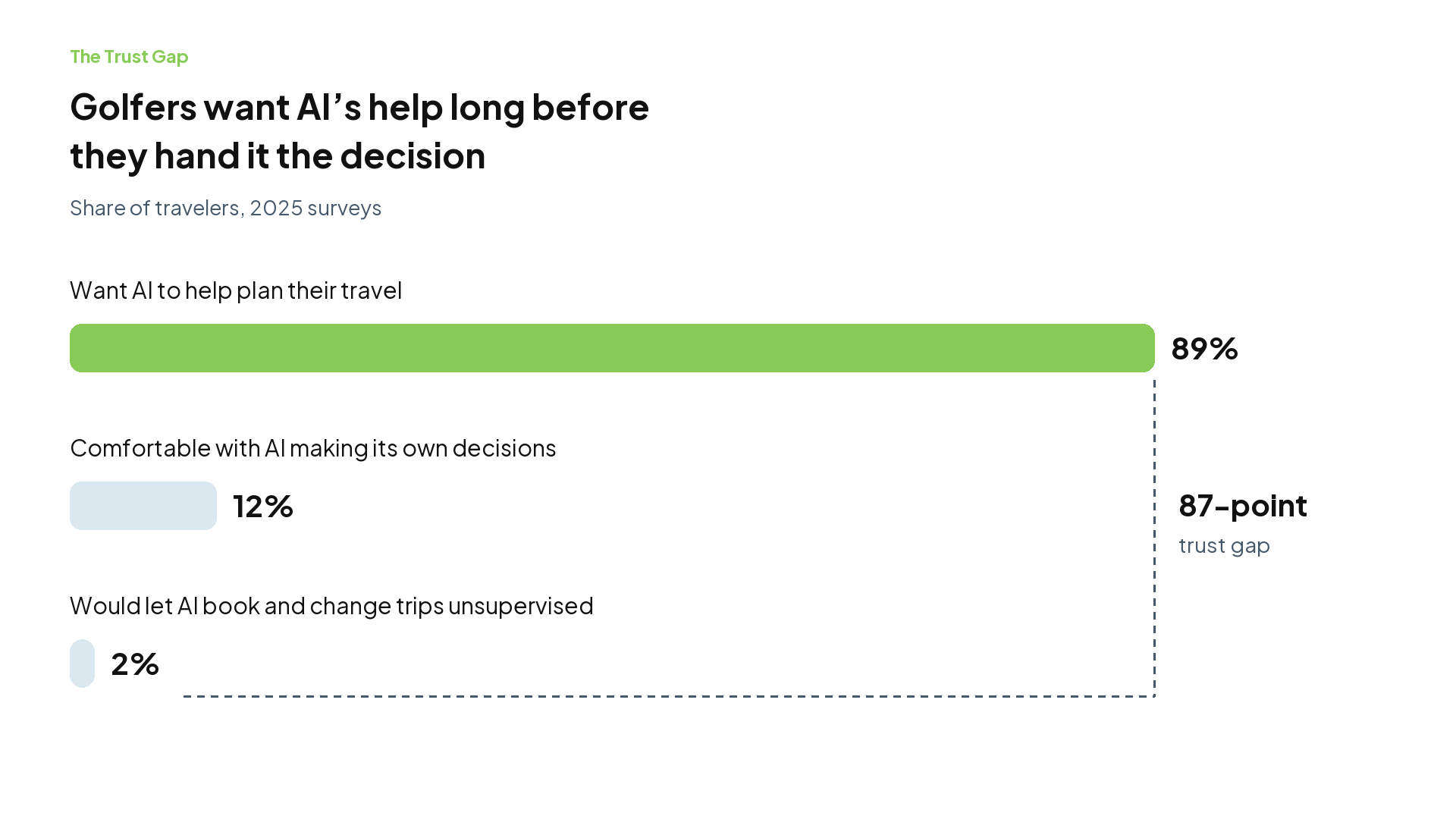
Golfers will let the agent do the work long before they let it decide.
But you don’t need full autonomy for this to move rounds. In practice, the agent brings back three tee times and the golfer taps one. That’s already how dinner reservations work. The contest for your course is simple: be one of the three options, with a bookable time attached.
And remember how quickly trust has flipped before. In 2009, getting into a stranger’s car was a crazy idea. So was sleeping in a stranger’s spare bedroom in a faraway city. So, not long before that, was typing your credit card into a box on a website instead of calling. Every one of those habits formed the same way: it worked, you didn’t get burned, and you went back.
Agents will earn trust the same way. You ask yours to book a tee time this weekend, it nails it, and you trust it a little more. If it’s already making your life easier with emails and reports, why wouldn’t it make your life easier booking travel?
Our conviction: by September 2027, that 2% that would let AI book unsupervised will be closer to 10%. By 2028, it could be 50%. Honestly, it could be 50% by this time next year. That’s how fast this is moving.
McKinsey describes a future where the golfer’s agent talks directly to the course’s agent. Many courses already run AI assistants on their own websites that answer questions about bookings, course conditions, and cart rules, so half of that conversation already exists.
Where Agents Get Stuck Today
An agent does five things between “find me a round” and a paid tee time. Today it handles the first two reasonably well and stalls on the last three.

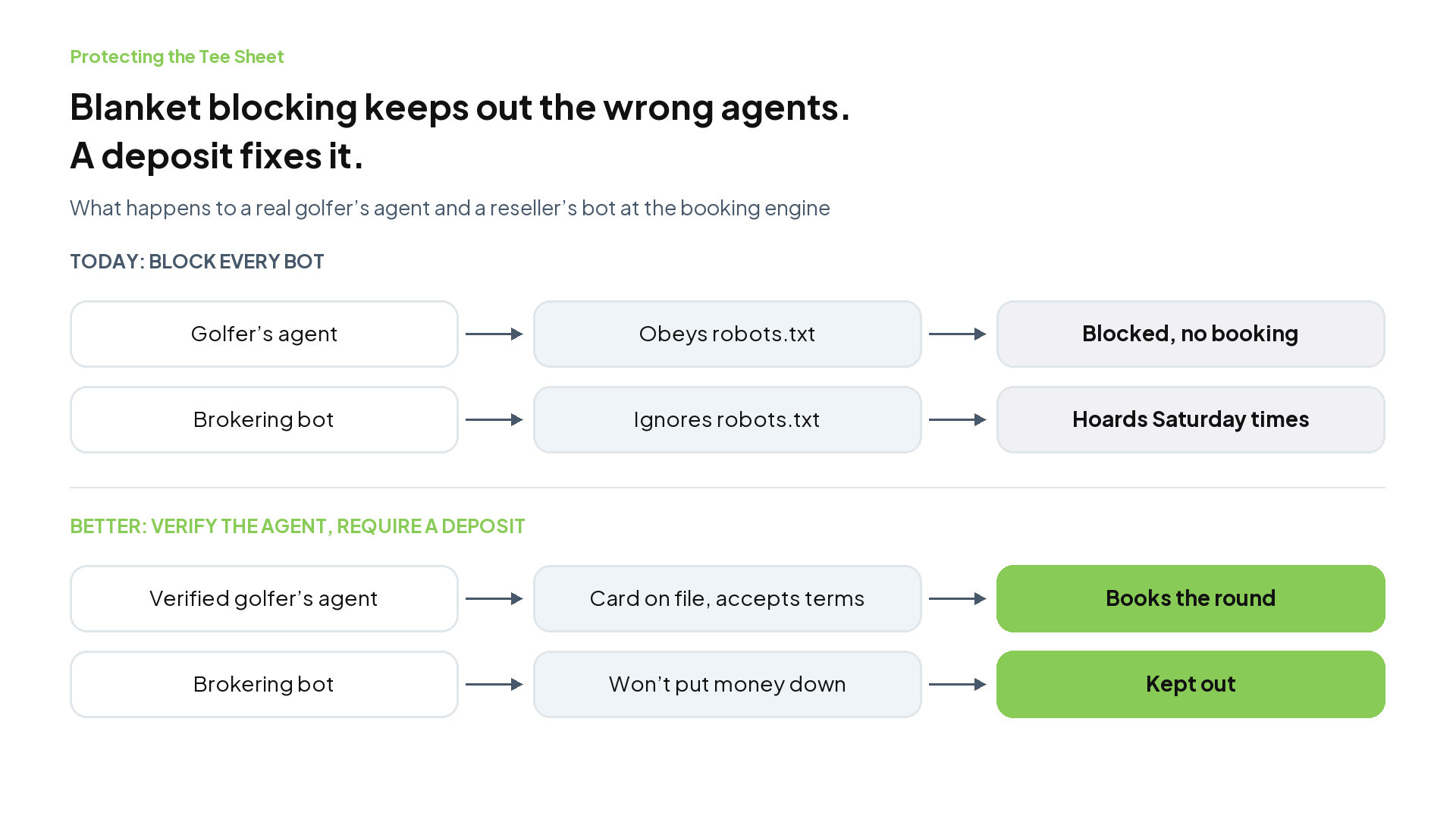
We tested this ourselves on a well-run daily-fee course with a good website. The agent read the weekend rate ($79 plus a $20 cart, so it fit under $100), the prepay terms, and the cancellation rule. Then it followed the Book Now link, and the booking engine’s robots.txt file told it to go away. GPTBot, ClaudeBot, PerplexityBot: all disallowed. No live time visible, nothing to hold, nothing to pay for.
Here’s the part that should bother you. A polite agent obeys robots.txt, but a brokering bot doesn’t. So that tee sheet keeps out the agents that follow the rules and lets in the ones that don’t.
Good Agents, Bad Bots
Some of you are thinking: I don’t want software booking my tee times. I’ve seen what bots do. That point is fair. Ticketmaster blocks around 20 billion bots a month. In Los Angeles County, bots grabbed prime tee times for resale across 34 courses.
But look at what actually fixed LA. It wasn’t a better blocker, it was a $10 non-refundable per-player deposit. Brokering collapsed with that policy change. Pacific Springs saw 60% fewer no-shows with a card on every reservation. A real golfer’s agent will put money down. A broker’s bot won’t do it a hundred times over.
If you don’t have a deposit or card-on-file policy yet, the agent era is your second reason to adopt one. Policies designed for human behavior turn out to be a strong defense against bad software.
Blocking everything is also running out of road legally. Amazon tried to keep Perplexity’s shopping agent off its site, won an injunction in March, and saw it overturned on appeal in August: the court held that it was Perplexity’s users, not Perplexity, accessing Amazon. Meanwhile, Cloudflare’s signed agents let a site admit cryptographically verified agents, like ChatGPT’s, while blocking unverified bots. The durable answer is telling an identified, deposit-paying agent apart from a scraper, and letting the first one in.
What We Don’t Know Yet
This is the bleeding edge, so it’s worth being honest about the open questions.
What will the agent recommend? There are 100 courses in Myrtle Beach. When a golfer asks for the best one, it’s a bit of a black box. Right now, being discussed on Reddit and in reviews seems to matter more than old-school SEO. One researcher invented a fake soap brand, posted about it on Reddit, and watched it become ChatGPT’s top recommendation. The rules are still being written.
Will there be ads? The most profitable business model ever created is search plus ads. Every AI company says sponsored content will never make it into answers. We’ll see. These platforms need revenue to support enormous valuations, and the most likely path is taking a toll on transactions. There’s a missing piece of the ecosystem right now: how does an operator get an offer and a price in front of an agent the way you used to put an ad in the paper or on Facebook? Nobody has cracked it yet.
Does third-party distribution disappear? Unlikely. Distribution will never collapse into one channel. But it will shift. If Google gets great at booking Hilton Head tee times, some intermediaries get squeezed. And we’ve seen this before: when Reserve with Google launched, the button often routed straight to a third party, scalping a booking off a search the course earned. Third parties will fight hard to keep that margin.
A More Human Future
Here’s a point that surprises people: agents won’t make golf less human. They’ll make hospitality more human.
We’re not fans of AI voice agents as consumers, and we don’t think most golfers are either. Golfers want an easy way to book online, or a high-touch human experience. Nobody wants an AI planning their $5,000-a-person golf trip; they want a trusted concierge they can call. The question is how that concierge manages 1,000 trips instead of 20, and the answer is better tools. When the phone rings, they already know Jordan’s preferences and last year’s trip, and the experience they give is ten times better than 45 minutes on hold or 15 emails back and forth.
The people in your pro shop won’t be replaced. They’ll have more time for the friendly greeting. When everyone is using agents for everything, people will crave that human connection even more. And the best version of an agentic search isn’t “find me a tee time in Denver.” It’s “book me next week at Ramblewood, because I love the experience I get there.”
Demand is strong right now, but demand isn’t a strategy. It will soften at some point, and we’re starting to see early indicators of this. The operators who own their inventory, their golfer data, and their distribution when that happens will have tools the industry didn’t have in 2008.
This is an incredible time to be an operator, because you own the inventory everyone else wants to sell. The golfer has always wanted the same thing: the right tee time, without friction. The agentic booking era is here. Let’s make sure it works for you this time.
Coming Next in This Series
- Part 2: Who owns the golfer when an agent books? What golf learned from the marketplace era, and how the economics change depending on how an agent reaches your tee sheet.
- Part 3: The operator’s playbook. Concrete moves for this quarter, this budget cycle, and your next contract renewal.
Watch our full presentation from the Noteefy Executive Retreat in Hilton Head, SC
Sources
- Noteefy Insights, aggregate data from 200+ course websites, 2022 to 2025
- Booking.com Global AI Sentiment Report, July 2025; Skift State of Travel 2025, cited by McKinsey
- Skift, Google’s agentic hotel booking tool comes to AI Mode, Aug 27, 2026; Skift on Marriott and Hilton 10-K filings, Feb 11, 2026; Skift, Oct 6, 2025; PhocusWire on Lighthouse, 2026
- OpenTable and OpenAI, Jan 2025; Yelp newsroom, Aug 10, 2026; coverage of OpenAI restaurant reservations, Aug 11, 2026; Semrush on Google AI Mode restaurant booking, Apr 2026; OpenTable via PYMNTS, Aug 26, 2026
- The Tech Caddie podcast, episode 44, Jan 2026
- WRAL on bots and AI tickets, June 2026; CNBC, June 27, 2026 and Mar 10, 2026; PYMNTS on the Perplexity appeal, Aug 2026; Cloudflare, The age of agents, Aug 28, 2025
- Canale and Haher (EY), The Agentic AI Marketplace Opportunity, TM Forum, June 2026; McKinsey, The Agentic Commerce Opportunity, Oct 2025
- Los Angeles County Parks and Pacific Springs GC case material, Noteefy Operator Revenue Playbook webinar, Apr 2026


