In This Article
What Is the Golf Customer Data Gap?
The golf customer data gap is the systematic challenges to capture contact information for golfers who play in slots 2, 3, and 4 of a booked tee time. Because tee sheet reservations record only the booking party, the average course misses data on 60-75% of the golfers who actually play and spend money there each day.
For most golf courses, customer data collection stops at the booking. But golf is a group sport and the way operators capture golfer data today means 60-75% of every foursome is completely invisible.
A foursome books a 9:12 AM tee time on your website Saturday morning. Your tee sheet captures the name, email, and phone number of the person who made the reservation. One golfer. One record. One data point.
The other three players? They show up, pay their green fees, ride your carts, eat your food, drink your beer, and walk out the door. And as far as your database is concerned, they were never there.
This is golf's version of what the hotel industry calls the "invisible guest" problem, and it's one of the biggest, most overlooked revenue leaks in course operations today.
The Booking Captain Problem
Let’s give it a name: the Booking Captain problem. In almost every foursome, one person does the booking. They’re the organizer, the planner, the one who checks the weather and grabs the tee time. Your system captures their data. Great.
But golf is inherently a group activity. The average tee time is 3–4 players. That means for every golfer record you collect through online booking, you’re missing two or three others. If you booked 200 tee times last Saturday, you might have data on 200 golfers — but 600 or more walked your course as ghosts. No name, no email, no way to reach them, no way to bring them back.
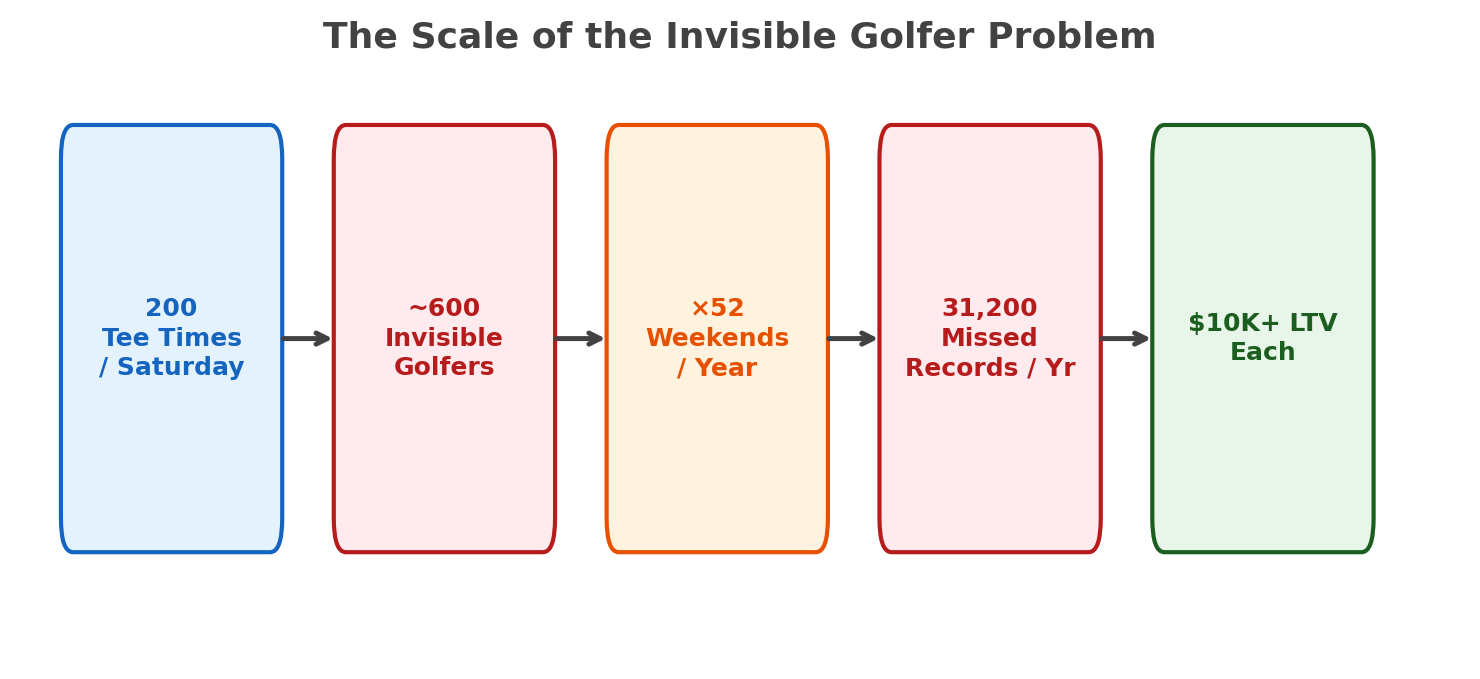
Think about that for a second. You’re potentially blind to 60–75% of the people who spend money at your facility on any given day.
Hotels Have the Same Problem and They’re Spending Millions to Solve It
Golf isn’t alone in this. The hotel industry has been wrestling with the companion guest data gap for years. When someone books a hotel room, the reservation captures the primary guest’s name and contact info. But every reservation averages three to four companion guests whose data the hotel never touches. Those companions sleep in the beds, use the amenities, experience the brand — and the hotel has zero way to market to them afterward.
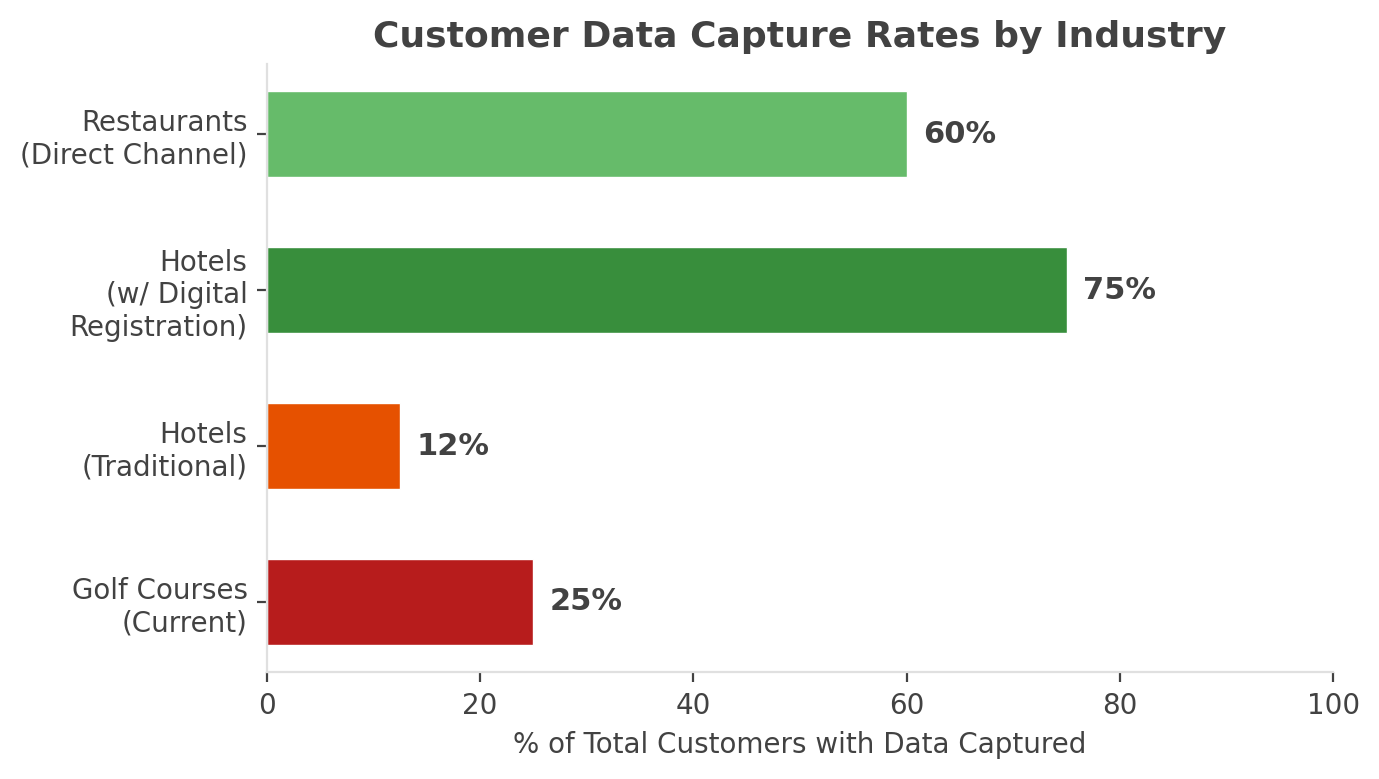
The numbers are staggering. Most hotels only capture data on 10–15% of all guests who actually walk through their property. Some hotel groups have invested in creative solutions — requiring all room occupants to register through a digital guest portal to access Wi-Fi or smart locks — and those systems push capture rates up to 70–80%. Hotels implementing companion guest data capture strategies have seen repeat direct bookings increase by up to 40%.
Restaurants face it too. A party of six books through OpenTable or Resy. The platform captures one diner’s information. The other five? Gone. This is why the smartest restaurant groups are pushing hard toward direct channels and loyalty programs that incentivize every diner - not just the one who made the reservation - to identify themselves.
The lesson from these industries is clear: the businesses that figure out how to capture data on all their customers, not just the one who initiated the transaction, build a fundamentally different kind of business.
What Those Missing Records Are Actually Worth
Let’s put some dollars on it. A golfer at a public course spends roughly $185–$210 per visit when you factor in green fees, cart rental, range balls, F&B, and pro shop. A golfer who plays your course 10 times a year represents $1,850–$2,100 in annual revenue. Retain them for five years and you’re looking at a lifetime value north of $10,000.
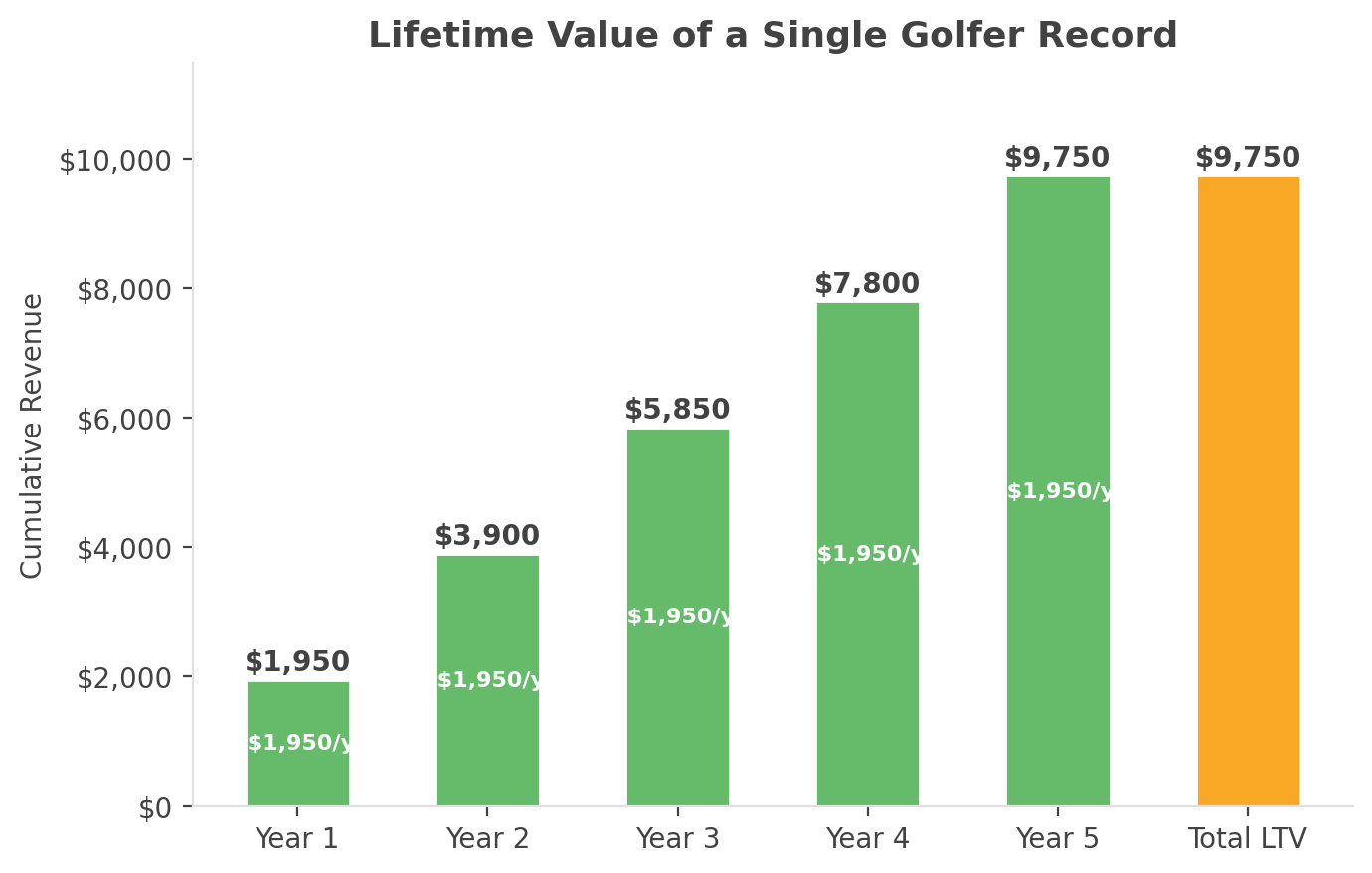
Now multiply that by the hundreds or thousands of “Player 2s, 3s, and 4s” who play your course every season and whose contact information you never capture. If even 10% of those invisible golfers could be converted into direct, marketable relationships — brought back for a weekday round they wouldn’t have otherwise booked, introduced to your league program, invited to an event - you’re talking about a meaningful revenue impact that costs almost nothing to unlock.
Acquiring a new customer costs 5–10x more than retaining an existing one. But here’s the thing: those golfers in slots 2, 3, and 4 aren’t new customers. They already played your course. They already experienced your product. They just need a reason — and a mechanism — to come back on their own, without waiting for their buddy to organize the next outing.
Why This Is So Hard in Golf
The reason golf has this problem is structural. The booking flow is designed around the tee time, not the individual golfer. One person books, the other names are often entered as free text — or not entered at all. The POS might capture a credit card swipe at check-in, but that data rarely flows back into the CRM in a useful way. And if someone in the group pays cash or gets covered by the Booking Captain? They’re truly invisible.
5 Ways to Start Capture More Player Data
There’s no single magic fix, but there are practical steps operators can take right now to start closing this gap:
- Individual Check-In Registration
Tablet at the start or window or mobile check-in link or QR code - Wi-Fi Email Capture
require an email address to log in for the Clubhouse WiFi. You tradeconnectivity for data. - Incentivize the Booking Captain
Offer range balls or food and beverage credit for entering playing partners' emails. - Post-Round Referral Link
"Share this link with your group for 10% off their next visit!" - Connect your Point-of-Sale to your Tee Sheet
Bridge your credit card transactions back to Goffer Profiles
Frame it around the experience. The key to all of these tactics is giving golfers a reason to share their information beyond “we want your data.” Whether it’s access to GPS scoring, a closest-to-the-pin contest entry, or a discount on their next round, the value exchange has to feel natural and worthwhile.
First-Party Data Is the New Gold, But Only If You Mine It
There’s a reason the customer data platform market is projected to hit $13 billion by 2031, and why first-party data strategies are delivering 2.9x revenue uplift across industries. The businesses that own direct relationships with their customers, all of their customers, not just the transaction initiators, have a compounding advantage that gets harder to replicate over time. Golf facilities report a 30% higher customer retention after implementing comprehensive CRM solutions.
But you can’t retain a golfer you don’t know exists. And right now, the average course doesn’t know that three out of every four golfers on their property even played there.
The courses that figure out how to close this data gap, the ones who find creative, low-friction ways to turn Player 2, Player 3, and Player 4 into known, marketable, retainable customers, are going to build a fundamentally stronger business than those who keep treating the Booking Captain as the only customer who matters.
The gold is already on your course. It’s walking your fairways every single day. You just need to pick it up.