

What Does Golf's No-Show and Cancellation Data Actually Show?
After 5 million confirmations, $28.7 million in recaptured revenue, and hundreds of thousands of cancellations processed across Noteefy courses, five lessons have emerged. The silent golfer, not the one who cancels, but the one who says nothing and doesn't show up is the real problem. Most cancellations happen in a 48-hour window that gives operators enough time to resell the slot. About 75% of golfers respond when asked to confirm. A single follow-up message recovers nearly half of the golfers who ignored the first. And the confirmation itself functions as legal documentation when a no-show fee needs to be enforced.
In This Article
Golf's tee sheets are fuller than they've been in decades. But somewhere between "booked" and "played," roughly 9% of those rounds disappear, and nearly 90% of them have nothing to do with weather. Since early 2025, Noteefy has processed more than 5 million tee time confirmations across daily-fee, municipal, resort, and multi-course operations. Here is what the data actually says.
Golf continues riding a historic demand wave. Recreational rounds have set records three times in the last four years, tee sheets at popular courses fill within minutes, and operators are enjoying pricing power they haven't seen in decades.
The bucket, in other words, is full. And since early 2025, the leak in the bottom of it is no longer a secret.
That's when Forbes, drawing on research from the National Golf Foundation and Noteefy, put hard numbers on what no-shows and short-shows cost public golf: somewhere between $1.2 and $1.5 billion a year across more than 10,000 public courses.
Roughly 9% of booked public rounds never show up, and only about 11% of those no-shows are weather-related.
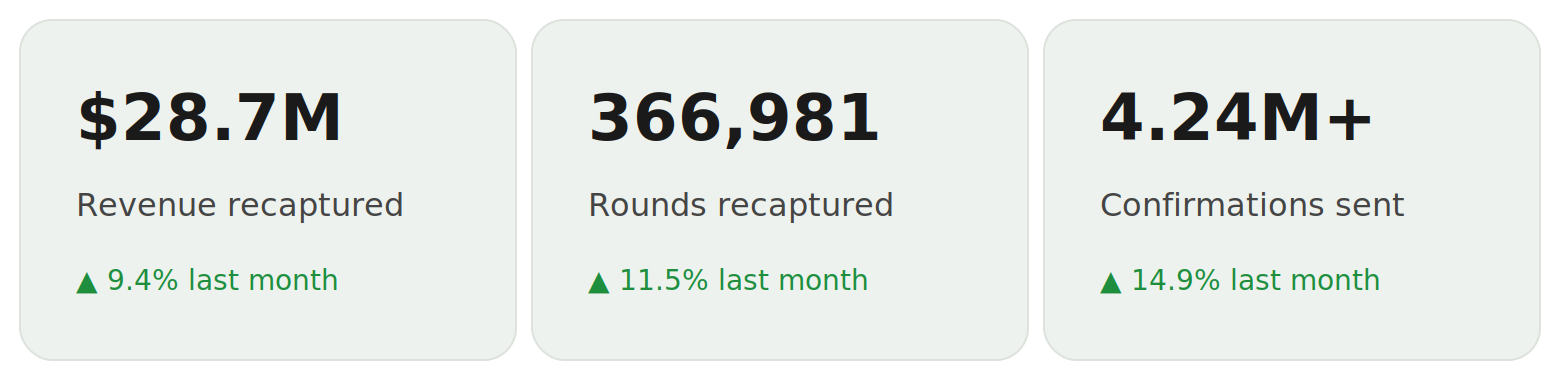
In the time since, Noteefy has processed more than 5 million tee time confirmations across daily-fee, municipal, resort, and multi-course operations: millions of golfer responses, hundreds of thousands of cancellations, and $28.7 million in recaptured revenue.
A year and a half later, here's what the data has confirmed, what it has sharpened, and what it has changed about how we think about cancellations.
Lesson 1: Cancellations aren't the problem, the silent golfer is
A cancellation notice, it turns out, is one of the best messages a golf course can receive. A golfer who cancels is handing you back perishable inventory while there's still time to resell it. The golfer who says nothing and simply doesn't show up is the one doing the real damage.
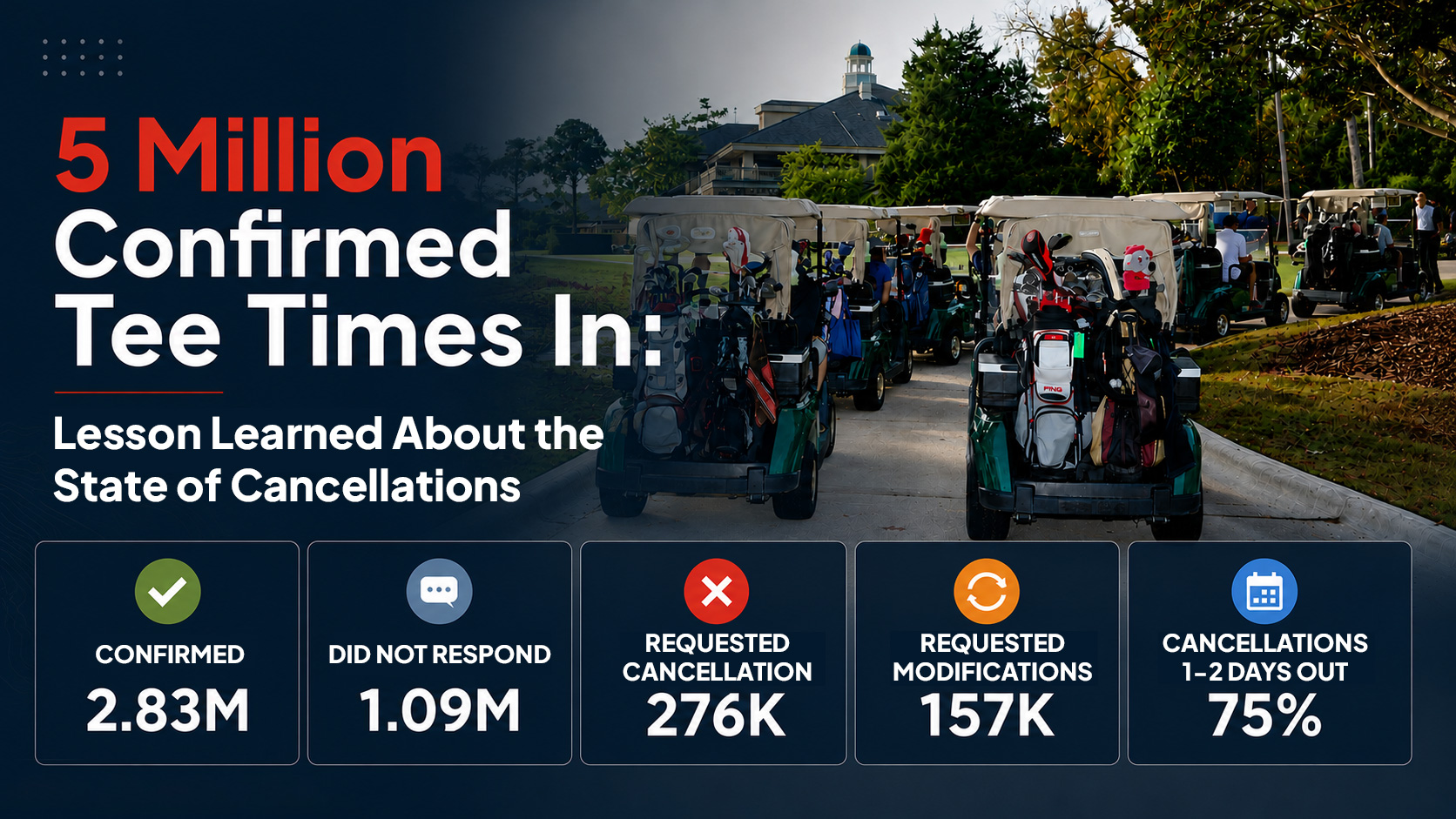
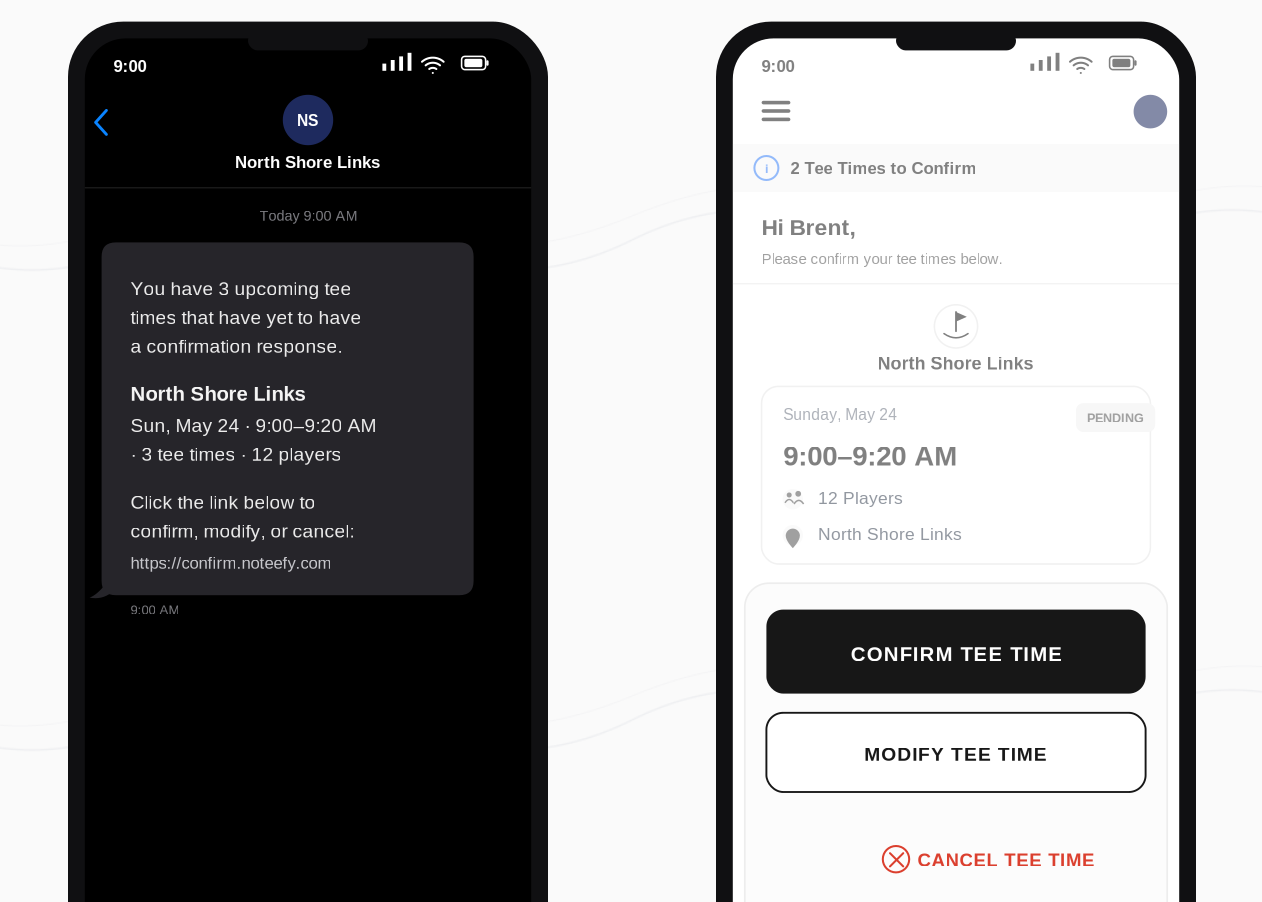
Our engagement data makes the contrast stark. Of the golfers we've contacted ahead of their rounds, more than 2.8 million confirmed their bookings, roughly 276,000 requested a cancellation, and 157,000 requested a modification. But more than 1 million never responded at all.
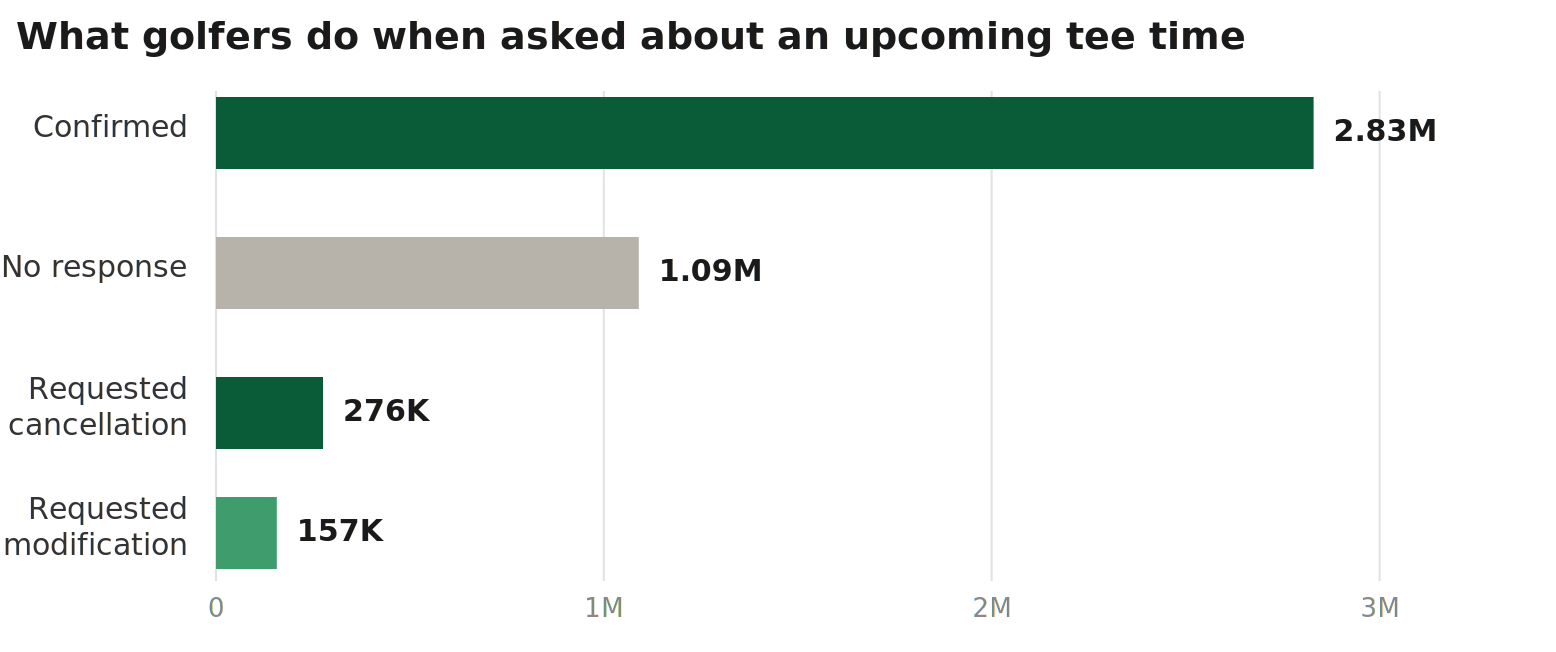
That silent segment, which is roughly one in four booked golfers, is where no-shows live. Every operator has a version of this group on their tee sheet right now. The goal isn't to eliminate cancellations; it's to convert silence into a signal, in either direction. A “yes, I'm coming” is valuable. A “no, I'm not” is nearly as valuable. The shrug is what costs you.
Making the cancellation policy clear in the follow up has been a reliable mitigation strategy to this.
Lesson 2: The 48-hour window is everything
When we chart cancellations by when they occur relative to the tee time, the pattern is unmistakable. Cancellations peak one day before the round, with two days prior close behind.
Together, that 1–2 day window accounts for roughly 75% of all cancellations we see, which is far more than day-of cancellations, and vastly more than anything four or five days out.
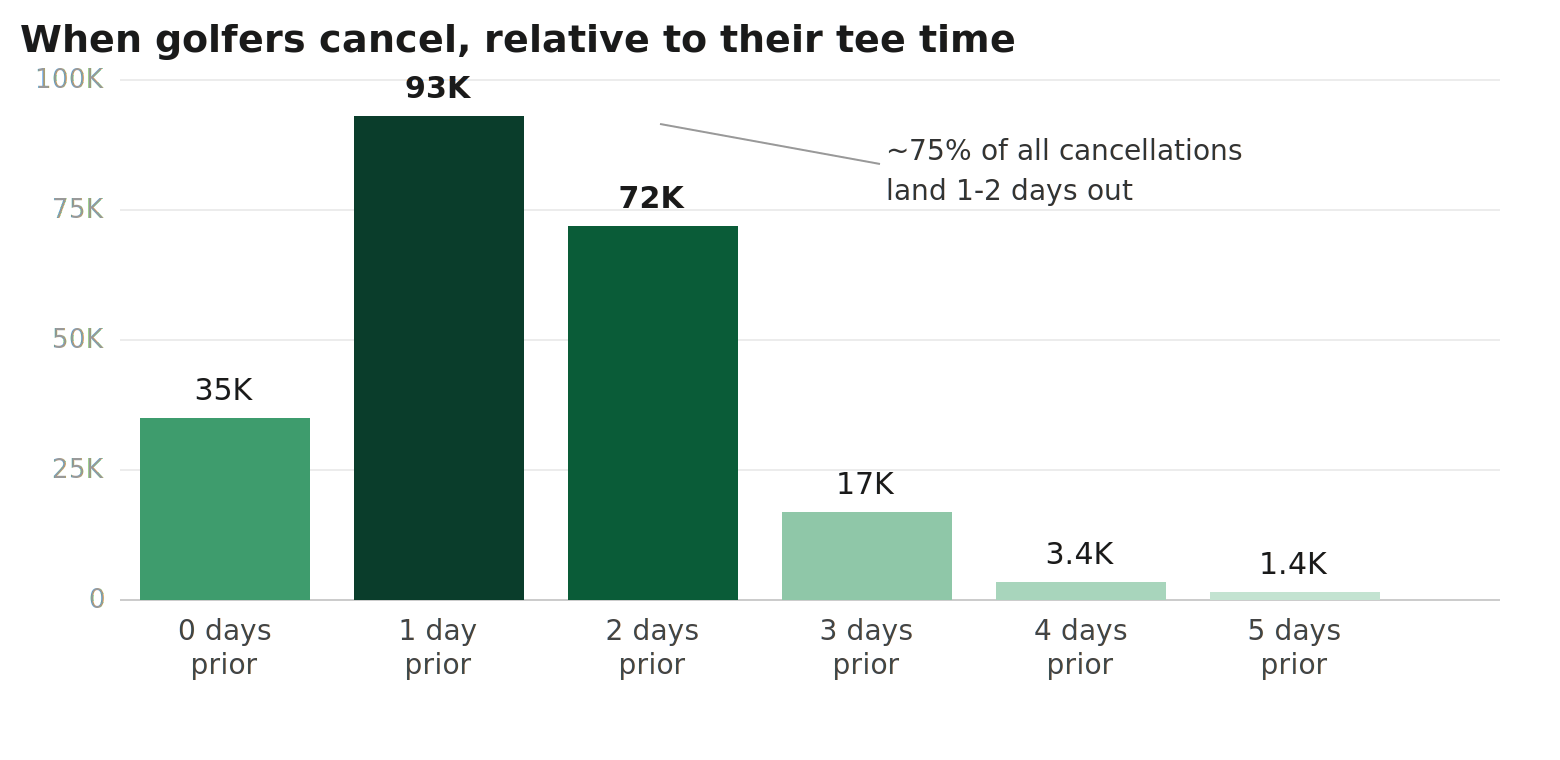
This is good news, and it's the most underappreciated fact about cancellation behavior. Most golfers who bail don't do so at the last second. They know a day or two ahead and cancel their tee time when there’s enough runway to resell the slot, but only if two things are true:
- You actually asked the golfer to confirm
- You have a mechanism (like an automated waitlist) that instantly routes the freed-up time to a golfer who wants it.
Confirm's approach, where reminders are sent one to two days before the tee time, was an informed bet built on early data. Five million confirmations later, it's a validated one: the prompt lands exactly when golfers are making their go/no-go decision. Ask too early and plans haven't firmed up, but ask day-of and there's no time left to rebook.
Lesson 3: Golfers will tell you, you just have to ask
When the Forbes article ran, a fair question hung over it: would golfers actually play along, or would confirmation requests feel like nagging?
With five million confirmations and about 75% of golfers responding when asked about an upcoming tee time, we have the answer: golfers will confirm, they cancel, they modify. Above all, they do engage.
The reason is simple: confirmation is a service, not a chore. It's the same reason your dentist and your airline remind you. Golfers with changing plans want an easy, guilt-free way to release a time; golfers who are coming appreciate the certainty.
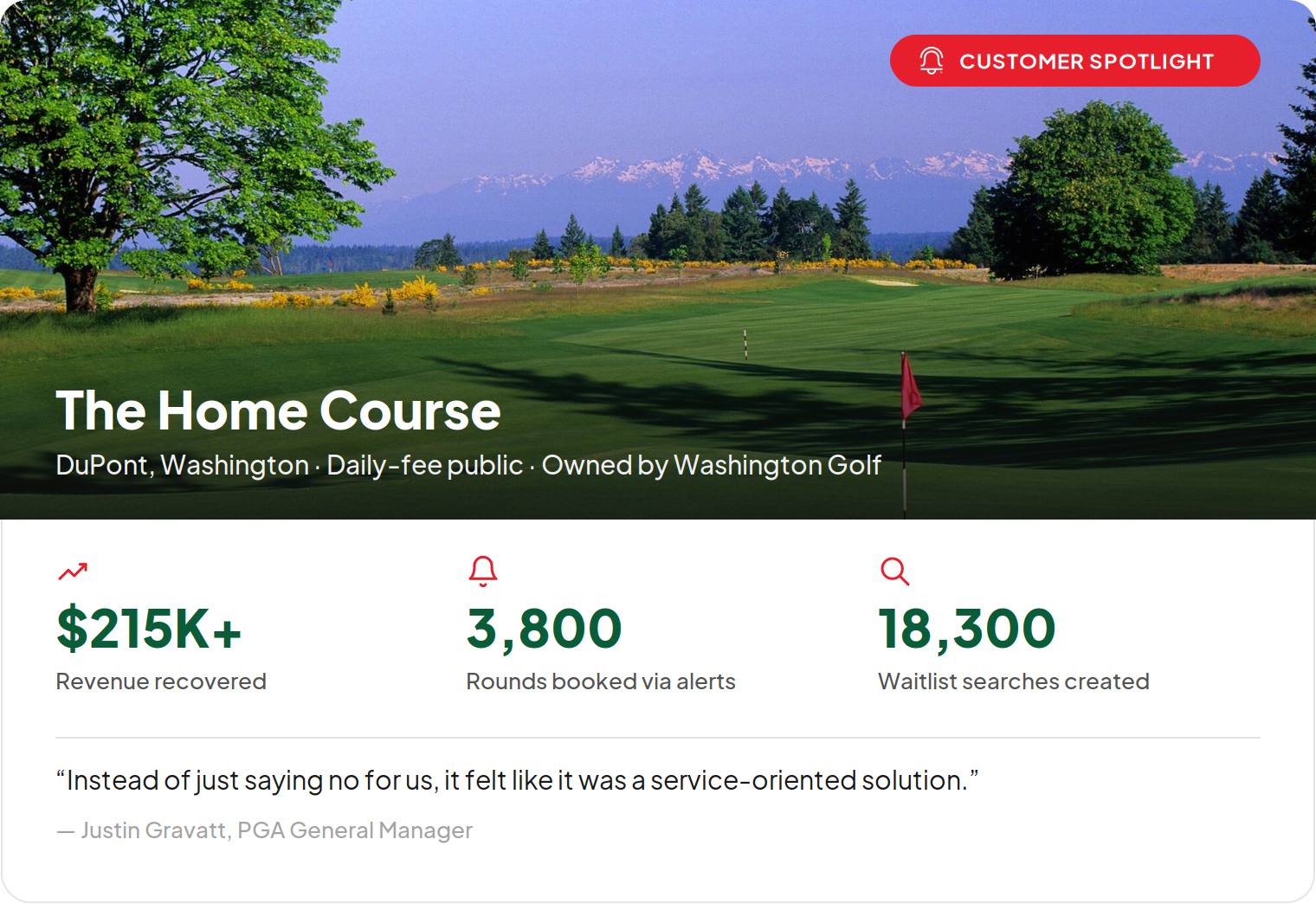
Justin Gravatt, the PGA General Manager at The Home Course in DuPont, Washington, put it well when describing the shift: “Instead of just saying ‘no’ for us, it felt like it was a service-oriented solution.” His team went from managing demand with sticky notes to recovering more than $215,000 and 3,800 rounds through automated alerts, and their golfers thanked them for it.
Lesson 4: The follow-up is worth almost as much as the first ask
One message isn't enough. Among golfers who don't respond to an initial request, a follow-up message gets a reply nearly half the time. That’s more than 746,000 recovered responses in our data that would otherwise have remained silence.
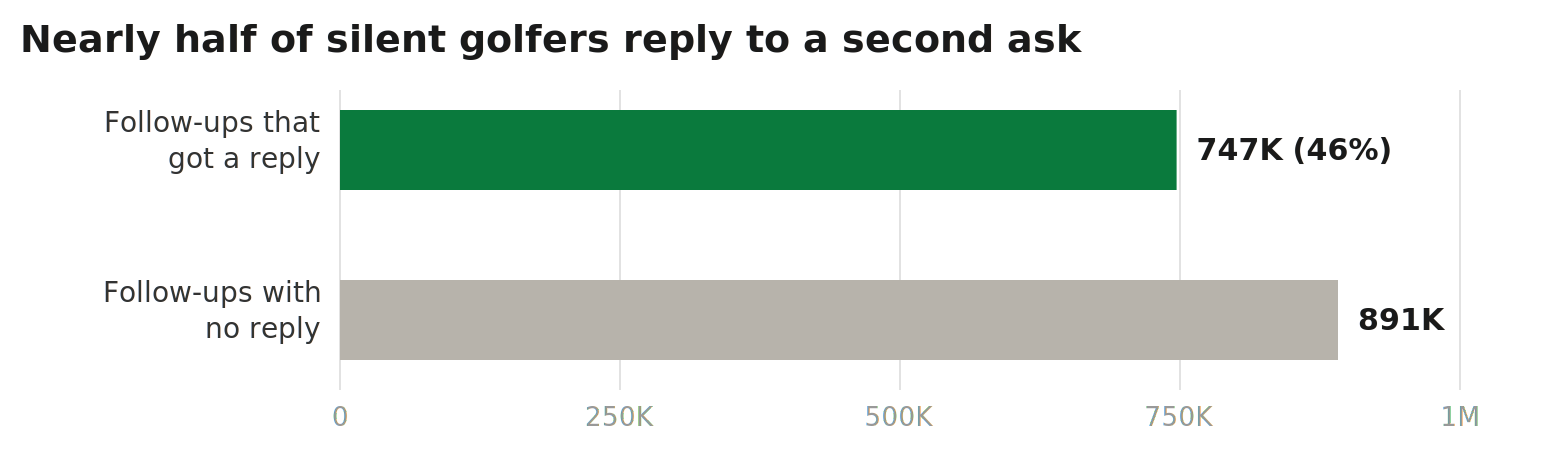
Think about what that means at the individual course level. If a quarter of your booked golfers ignore the first touchpoint, a single well-timed follow-up converts almost half of that risk pool into a known quantity: a confirmed round you can count on, or a released slot you can resell.
Persistence, automated so it costs your staff nothing, is one of the highest-ROI behaviors in tee sheet management.
Lesson 5: A confirmation is a revenue event and a receipt
Across our platform, courses have recaptured 366,981 rounds and $28.7 million in revenue from cancellations that would previously have gone unfilled, equating to roughly $78 per recaptured round before you count cart fees, food and beverage, and pro shop spend, which the National Golf Foundation estimates push the true value of an occupied tee time 40–50% above the green fee alone.
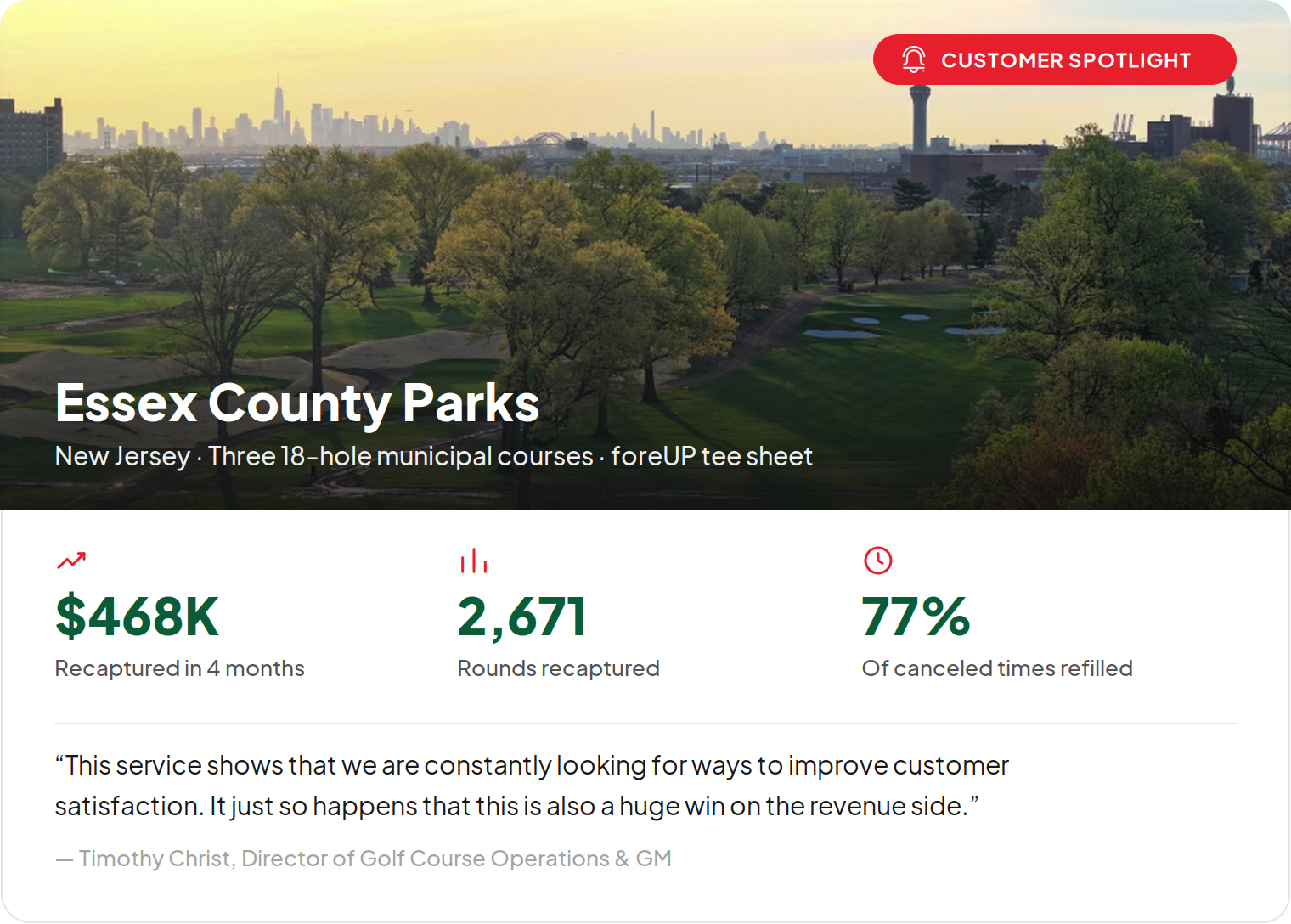
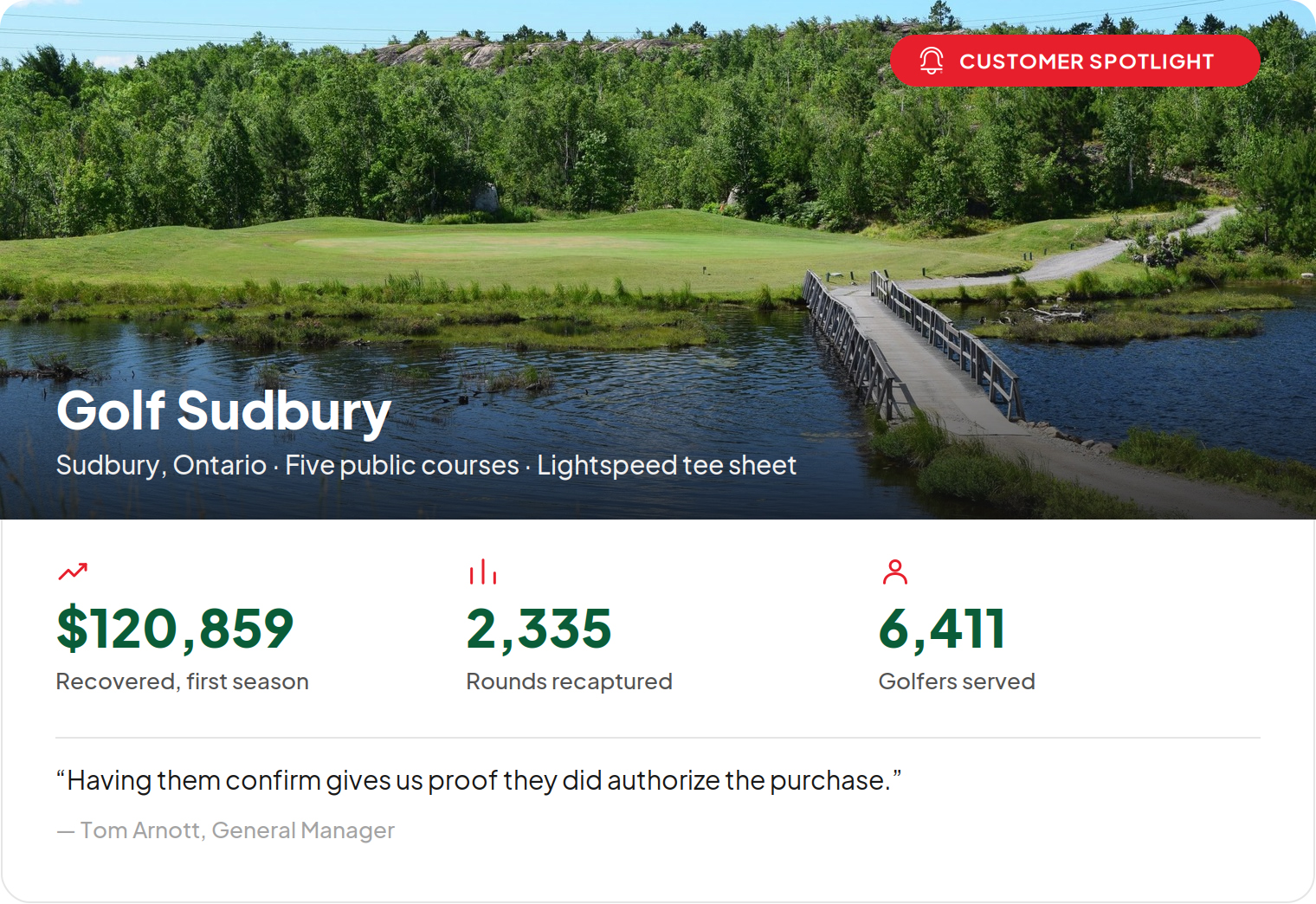
The case studies show what this looks like on the ground. Essex County Parks in New Jersey recaptured $468,000 and 2,671 rounds across three municipal courses in just four months, refilling 77% of canceled times. Golf Sudbury, a five-course operator in Ontario, recovered $120,859 in its first season despite a frost-delayed spring.
But Sudbury's experience surfaced a second, less obvious benefit: the confirmation itself is documentation. Like many operators, they wanted to enforce a no-show fee but kept losing chargeback disputes.
“Having them confirm gives us proof they did authorize the purchase,” GM Tom Arnott told us. The confirmation record became their defense. It's the same lesson the Forbes piece drew from Okeeheelee Golf Course in Palm Beach County where card-on-file bookings and a modest no-show fee produced a no-show rate 75% below market. Policy works, and a confirmation trail is what makes it enforceable.
Where the industry goes from here
When Forbes and the NGF put a billion-dollar number on no-shows, the open question was whether golf would respond the way airlines, hotels, and restaurants once did with reminders, policies, and consequences. A year and a half and 5 million confirmed tee times later, the answer is taking shape. The playbook the data validates is clear: ask every golfer to confirm in the 48-hour decision window, follow up with the silent ones, backstop it with a waitlist that instantly resells released times, and put a fair policy with a paper trail behind it all.
Golf's demand boom won't last forever, and the operators who thrive in the next cycle will be the ones who stopped treating “booked” and “played” as the same number. The problem was named in 2025, but the data now shows it's solvable: fuller tee sheets, happier golfers, and a lot less revenue leaking out the bottom of a very full bucket.



.png)