In This Article
- Setting the stage: the most famous people on earth are now golf-obsessed, in public
- Shift #1: The perception of golf flipped, and the reach is enormous
- Shift #2: The funnel is converting into actual green-grass rounds
- Shift #3: The audience YouTube reaches is exactly who is buying tee times now
- Shift #4: The capital markets have already validated it
- What it means for your bottom line
- The catch: demand only counts if you actually capture it
- Bringing it home: the funnel is full. Go capture it.
- Key Takeaways
- FAQ
Does YouTube and Celebrity Golf Actually Drive Rounds and Revenue?
Yes. The evidence is now measurable across four layers: golf's public perception has flipped from negative to mainstream, on-course participation has hit its highest level since the Tiger Woods era, the demographic YouTube golf over-indexes on matches exactly who is driving rounds growth, and capital markets have priced the demand in as structural. The cultural engine has done its job. The growth opportunity now belongs to operators who build the transaction layer to capture what it sends them.
Celebrity and YouTube golf have turned 136 million Americans into golf's audience. The question operators should be asking isn't whether LeBron James and Kevin Hart are good for the game, it's whether your tee sheet is built to capture the demand they're sending your way.
The most famous celebrities and athletes on earth are now golf-obsessed, in public.
In November 2025, the greatest basketball player of his generation tweeted, to 50-plus million followers, that he had become obsessed with YouTube golf videos. Not the Masters. Not Tiger. YouTube golf.
LeBron said he had never even thought about the game eight months earlier, then went down a rabbit hole through the Bryan Bros, Grant Horvat, and Bob Does Sports, and within months was filming his own four-man scramble with Bob Does, in-season, for the world to watch.
Then there is Kevin Hart, who played his first-ever round in the summer of 2025 and by April 2026 was strolling Augusta National as Bryson DeChambeau's caddie at the Par 3 Contest while declaring on nearly every Instagram post “golf is life and life is golf!!!”
LeBron and Hart even have a golf grudge match on the calendar for September 2026, and LeBron's pre-match trash talk was exactly what you would expect.
Steph Curry, the Kelce brothers, Tom Brady, Pat Maholmes, Adam Sandler. Everywhere you look online… Golf has become mainstream in celebrity culture.
Beyond the vibes and viral clips, the data is showing that this is a massive tailwind for golf’s future growth. Celebrity distribution of the game is the single largest, cheapest top-of-funnel marketing engine golf has ever had, and it is converting into rounds.
Let's dig into the numbers.
Shift #1: Free marketing and content distribution has flipped the perception of golf, and the reach is enormous
A decade ago, roughly 60 percent of Americans viewed golf negatively. Country-club gatekeeping, slow, stuffy, not for them. That image is gone. According to the National Golf Foundation, about 2 in 5 Americans now play, watch, follow, or engage with the game in some form, and golf's total "reach" sits around 136 million people.
A huge driver of that flip is a media layer that did not exist twenty years ago. Good Good (nearly 2 million subscribers and now the title sponsor of a PGA Tour event in Austin), Bob Does Sports, Fore Play, and creators like Rick Shiels have made golf feel loud, funny, and accessible instead of intimidating. Tour pros feed the same machine. Bryson rebuilt his entire public image on the platform.
This moment golf is having feels different. It feels more grass roots and ground up.
- Chad Mumm, creator of Netflix's 'Full Swing'
The content does the awareness work the industry used to pay millions for. A newcomer watches a relatable plus-handicap creator hack it around with their buddies, and golf stops looking like a ritual and starts looking like something they could do this Saturday. That reframing is worth a fortune you no longer have to spend.
Shift #2: The funnel is converting into actual green-grass rounds from net new golfers
The awareness of golf is turning into play, which is the desired effect.
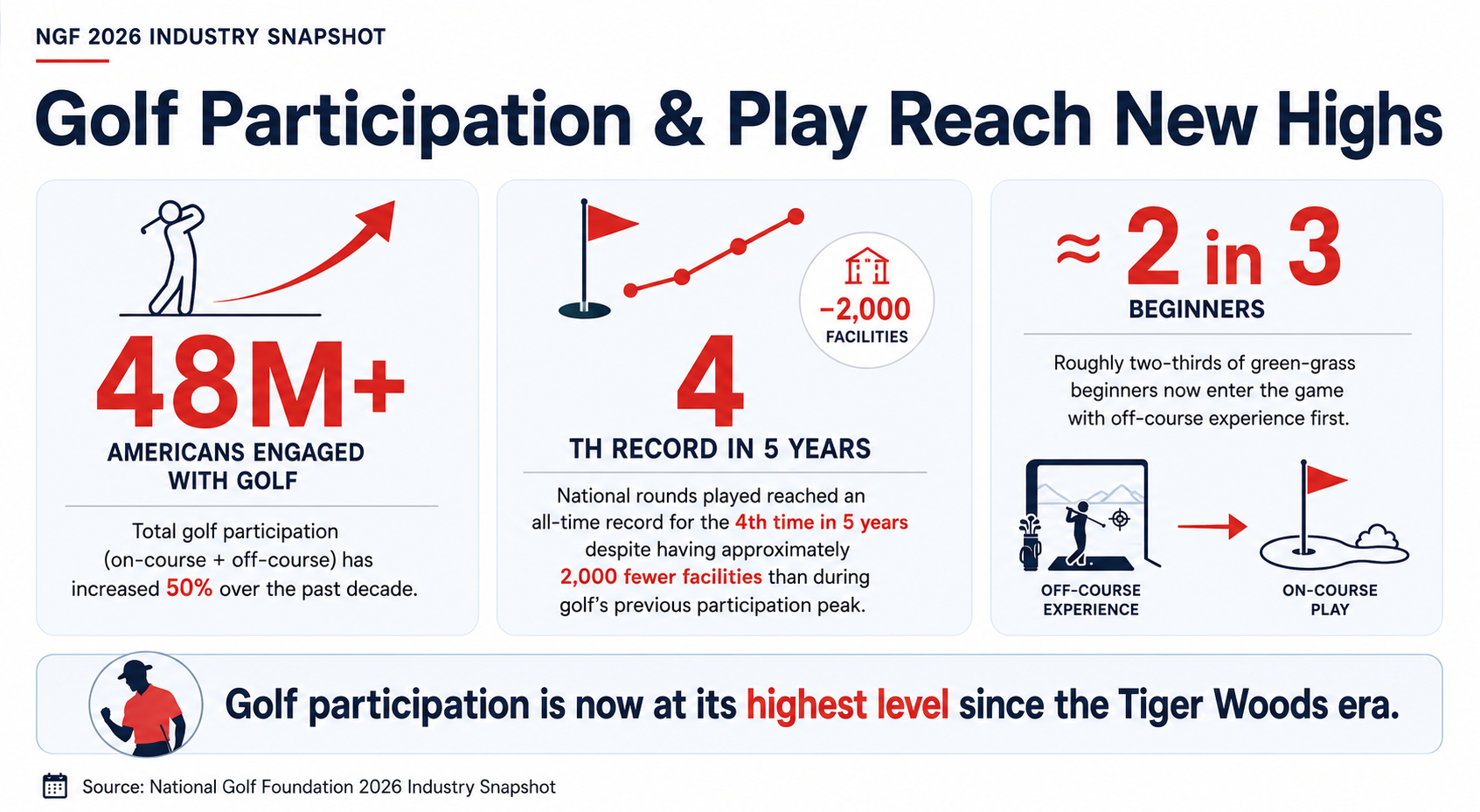
From the NGF's 2026 industry snapshot:
- On-course participation is at its highest level since the Tiger Woods peak era of the late 1990s and early 2000s. Total participation, on and off course, is up 50 percent over the past decade to more than 48 million Americans.
- National rounds played hit another all-time record, the fourth time in five years, and we did it with roughly 2,000 fewer facilities than existed during that earlier peak.
- Roughly two-thirds of green-grass beginners now enter the game with off-course experience first.
The rapid rise in golf online + culture, paralleling on course and off course skyrocketing participation, suggest there is a strong relationship.
The simulator bay, the entertainment venue, the late-night YouTube binge are increasingly the on-ramp to the first real tee time.
Shift #3: The audience YouTube reaches is exactly who is buying tee times now
Here is why the creator engine is so valuable to operators specifically. The demographic YouTube golf over-indexes on, younger, with money, highly engaged, lines up almost perfectly with the cohorts driving golf's growth.
- More than 8 million women and girls now play on course, an all-time high and a 46 percent jump versus 2019.
- Diversity is at record levels, with women at 28 percent of on-course golfers and People of Color at 26 percent, both new highs.
- The 18-to-34 crowd is now a major share of on-course play, and golfers under 50 are responsible for the majority of rounds growth since 2019.
When Bronny James shows up in Grant Horvat content, a million young viewers see a version of golf that finally looks like them. That is your future regular, discovering the game on a screen before they ever walk through your door.
Shift #4: The capital markets have already validated it
The Wall Street Journal recently ran a piece headlined that golf is now cooler and younger, and the stock market has noticed. Equipment sales hit all-time highs in 2025. Golf ball shipments, a clean proxy for rounds, posted a fifth straight year-over-year increase. Golf-exposed stocks across equipment, apparel, and hospitality have caught a bid because investors see a bigger, younger, more durable market.
The creator economy itself has gone institutional. Forbes has tracked YouTube golfers going for serious green: Good Good raised 45 million dollars, Barstool and Bob Does Sports ran an Internet Invitational with a seven-figure purse, and Grant Horvat has turned down PGA Tour starts because his audience, not the Tour, is the asset. When venture capital and public equity both pile in, that is a signal the demand underneath is structural, not seasonal.
What it means for course operators
Strong, sustained demand against flat supply is the best macro setup operators have seen in a generation, and it is already in the P&L.
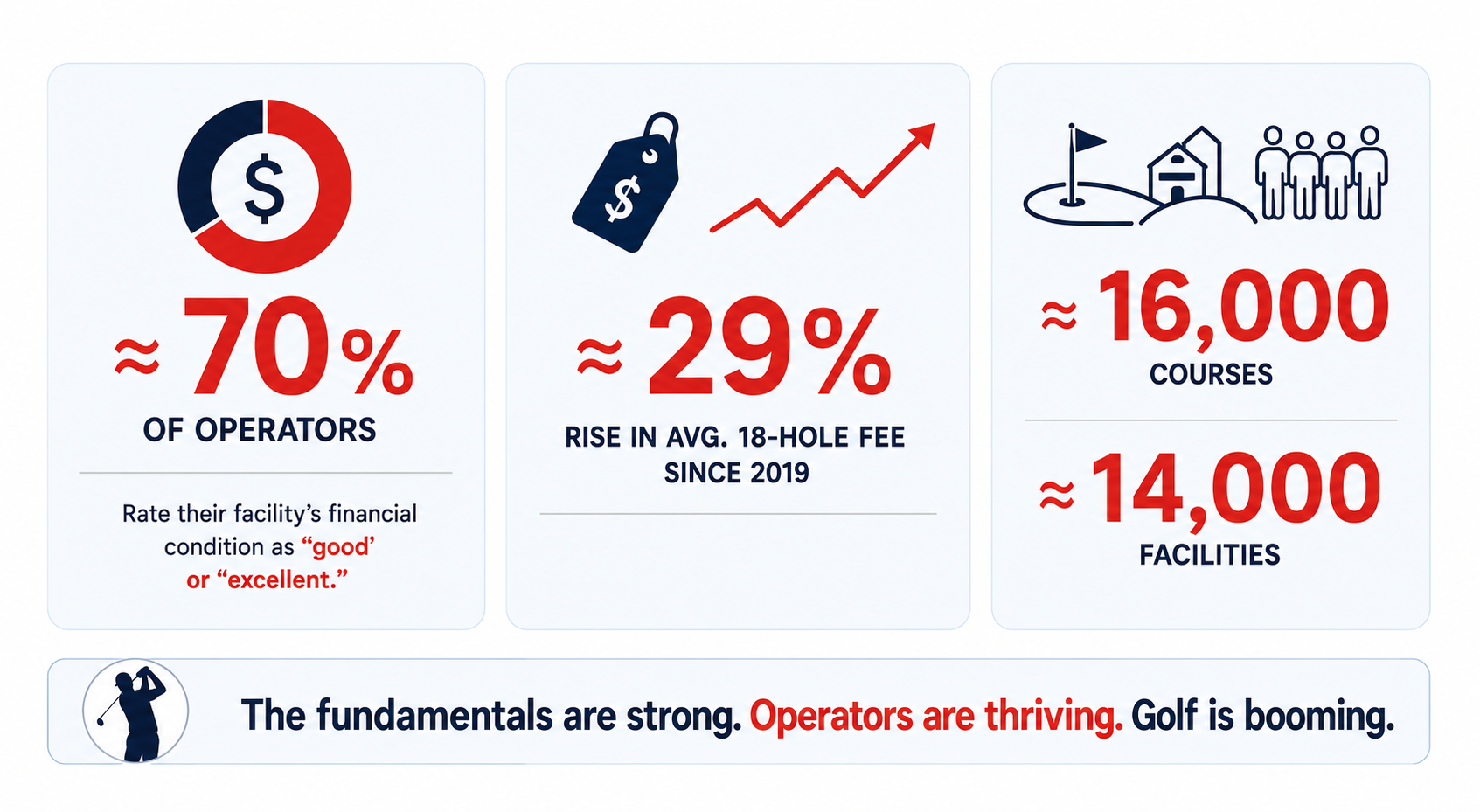
- Nearly 70 percent of operators now rate their facility's financial condition as "good" or "excellent."
- Public golf has regained pricing power, with the average 18-hole fee up roughly 29 percent since 2019, broadly in line with cumulative U.S. inflation. That is not gouging. That is finally getting paid.
- With roughly 16,000 courses at nearly 14,000 facilities, the U.S. remains the largest golf market on earth, and those facilities are busier than ever.
The catch: demand only counts if operations effectively capture it
NGF's Greg Nathan keeps pointing at what he calls golf's "vulnerable underbelly." His point: even with the business booming, intimidation and friction still stop millions of interested would-be golfers from ever walking through the door. The awareness problem is largely solved. The capture problem is not, and that is the part you control.
Think about who that LeBron tweet or that Bob Does video actually produces. A high-intent newcomer who just decided, on their couch, that they want to play. They have a short attention span and a phone in their hand. If your tee sheet is buried on a clunky website, if booking means calling a pro shop that does not pick up, if your only visible times are off-peak windows nobody can find, that demand leaks right back out and books down the road instead.
The opportunity is to treat all this cultural momentum as exactly what it is: a pipeline of new and returning players arriving at your tee sheet, all day, for free. Capturing it means making the booking moment effortless, knowing every golfer in the foursome instead of just the one who booked, surfacing your real live availability so a high-intent newcomer can convert on impulse, and using dynamic pricing and waitlists to fill the off-peak white space the industry pegs at roughly 50 million untapped rounds a year.
Bringing it home: the funnel is full. Time to capture it.
So, does YouTube and celebrity golf fill tee sheets and drive course revenue? Yes. The perception flip is measurable, the funnel from couch to first tee is proven, the demographics line up, and Wall Street has already priced in that the demand is durable. The cultural engine has done its job and it is not slowing down.
The next dollar of growth belongs to the operators who build the transaction layer to catch everything it sends them. The famous people got the world curious. Your job is to make sure that when they go to book, you are the easiest yes on the screen.
Sources: National Golf Foundation, 2026 Graffis Report and "Golf's State-of-Industry in 3 Minutes"; Greg Nathan on NGCOA's Golf Business Live, "Supply, Demand, and Golf's Vulnerable Underbelly"; The Wall Street Journal, "Golf Is Now Cooler and Younger. The Stock Market Has Noticed."; Forbes, "How YouTube Golfers Are Going For Serious Green." Celebrity reporting via Athlon Sports, MyGolfSpy, Bleacher Report, Global Golf Post, and Golf Channel. All graphics original to Noteefy / Revenue Alert.