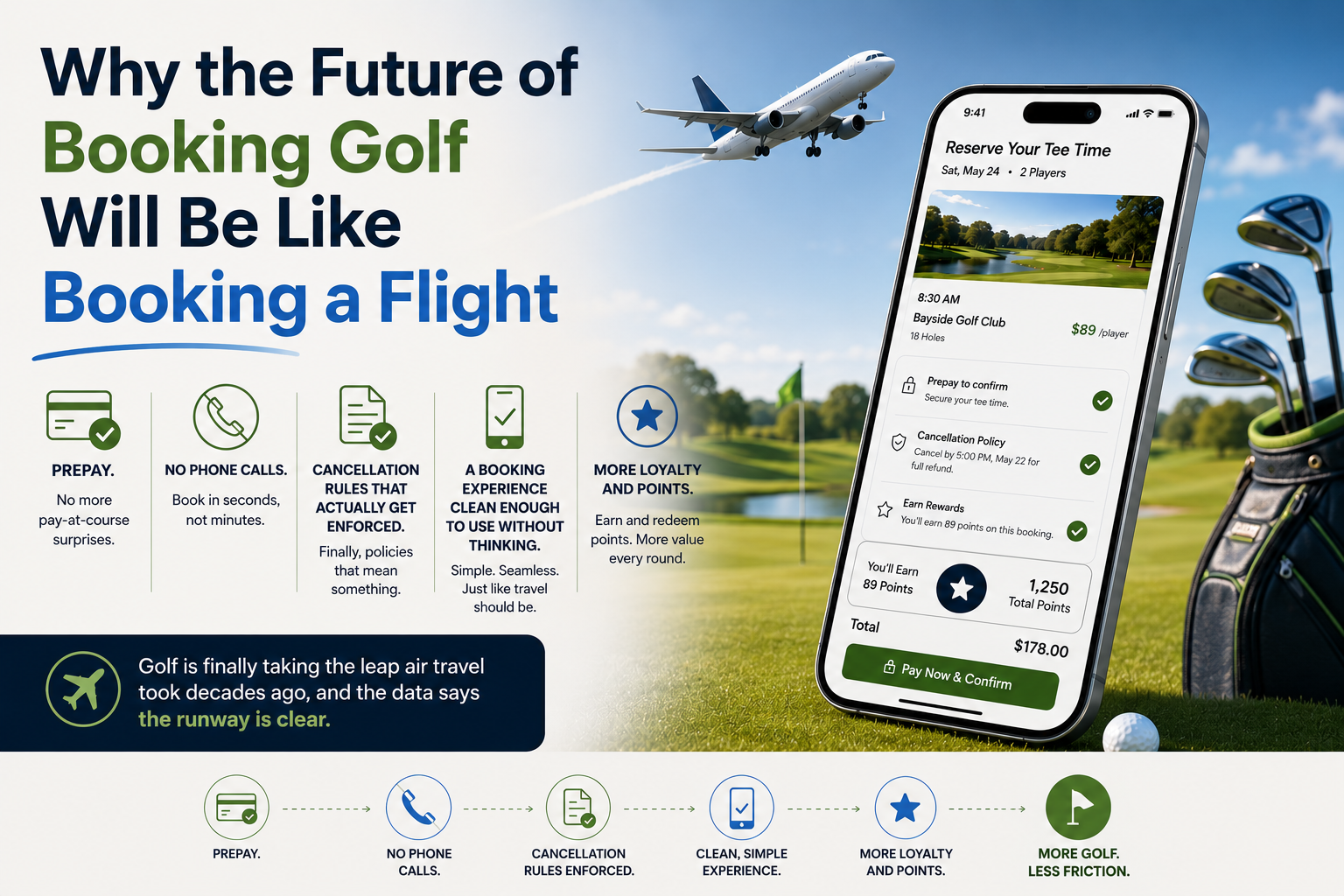
Why Will Booking a Golf Tee Time Feel Like Booking a Flight?
The future of booking golf will mirror air travel through five converging shifts: golfers will prepay at the time of booking, phone reservations will fade as online booking experiences improve, cancellation policies will be clearly defined and automatically enforced, booking will become fast and increasingly AI-assisted, and all of it will be powered by loyalty built into the booking itself. Golf is following the same path airlines walked decades ago, and the data shows both golfers and operators are ready.
In This Article
- Setting The Stage: Airlines Have Figured Out How to Optimize the Direct Booking Experience
- #1: Golfers will pre-pay when booking in the future.
- #2: Golfers will stop calling the pro shop to book, because the screen will finally be better than the call and courses will no longer accept those calls
- #3: Operators will clearly define and enforce their cancellation policy
- #4: Booking will be fast, clean, and increasingly conversational with AI assistance
- #5: Underneath all Four: Loyalty Embedded into Bookings
- Bringing it home: The runway is clear. Time for golf courses to take action!
- Key Takeaways
- FAQ
Just like booking a flight, the standard for booking a tee time will have: Prepay. No phone calls. Cancellation rules that actually get enforced. An AI assisted booking experience clean enough to use without thinking. And a loyalty program that drives LTV. Golf is finally taking the leap air travel took decades ago, and the good news is that with the right technology + policies the runway is already clear.
Setting The Stage: Airlines Have Figured Out How to Optimize the Direct Booking Experience
Picture booking a flight by calling the airline. You dial United, wait on hold, describe where you want to go, let an agent read you fares one at a time, spell your name twice, and read your card number out loud over the phone. It is a funny image, because nobody has booked air travel that way in years. An airline that tried to run on it today would not last a quarter.
Airlines like United have invested billions into their online booking technology because the alternative is they go to an OTA (Online Travel Agency) that takes a massive cut of revenues, go to a competitor, or just pick up the phone and call - which is a massive operational burden.
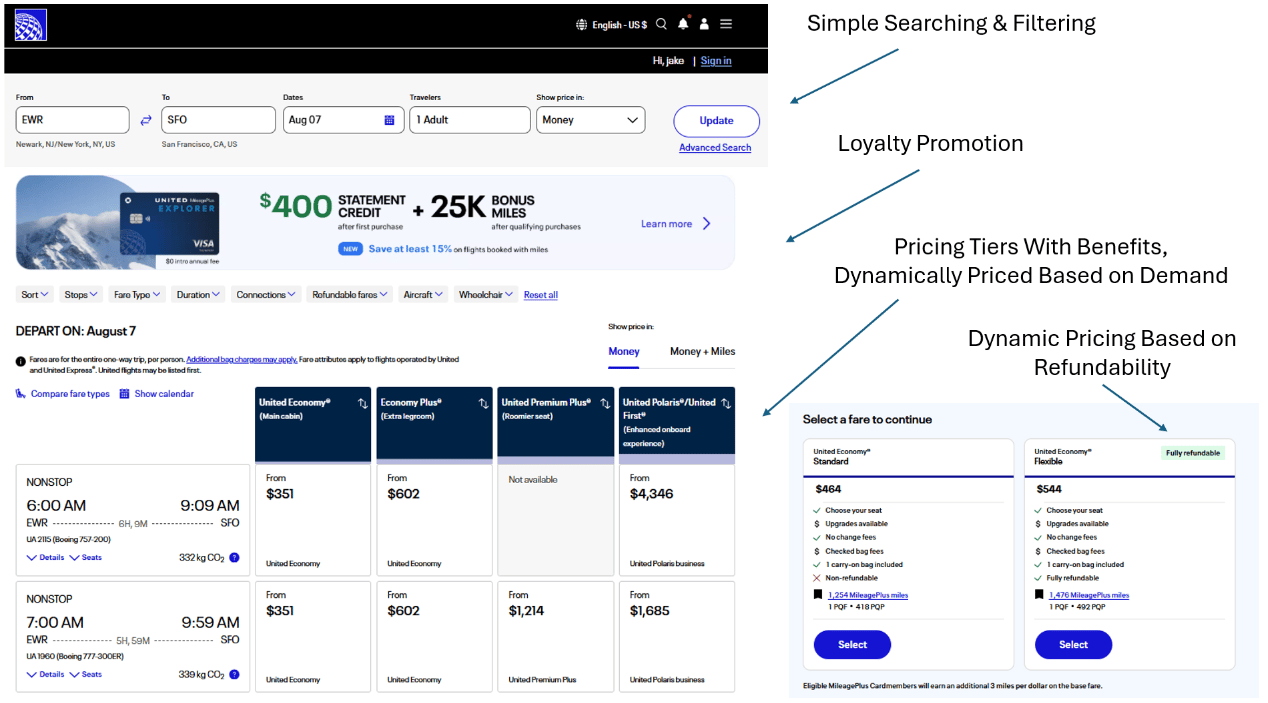
Now think about how a lot of golf still gets booked. After looking at a clunky online interface, many golfers call the pro shop. Often someone behind the counter puts down what they were doing, picks up the phone, talks through availability, types a name into the tee sheet, and collects nothing. No payment, no commitment, no email, no profile, just a name in a slot. If you have worked a counter, you know the scene.
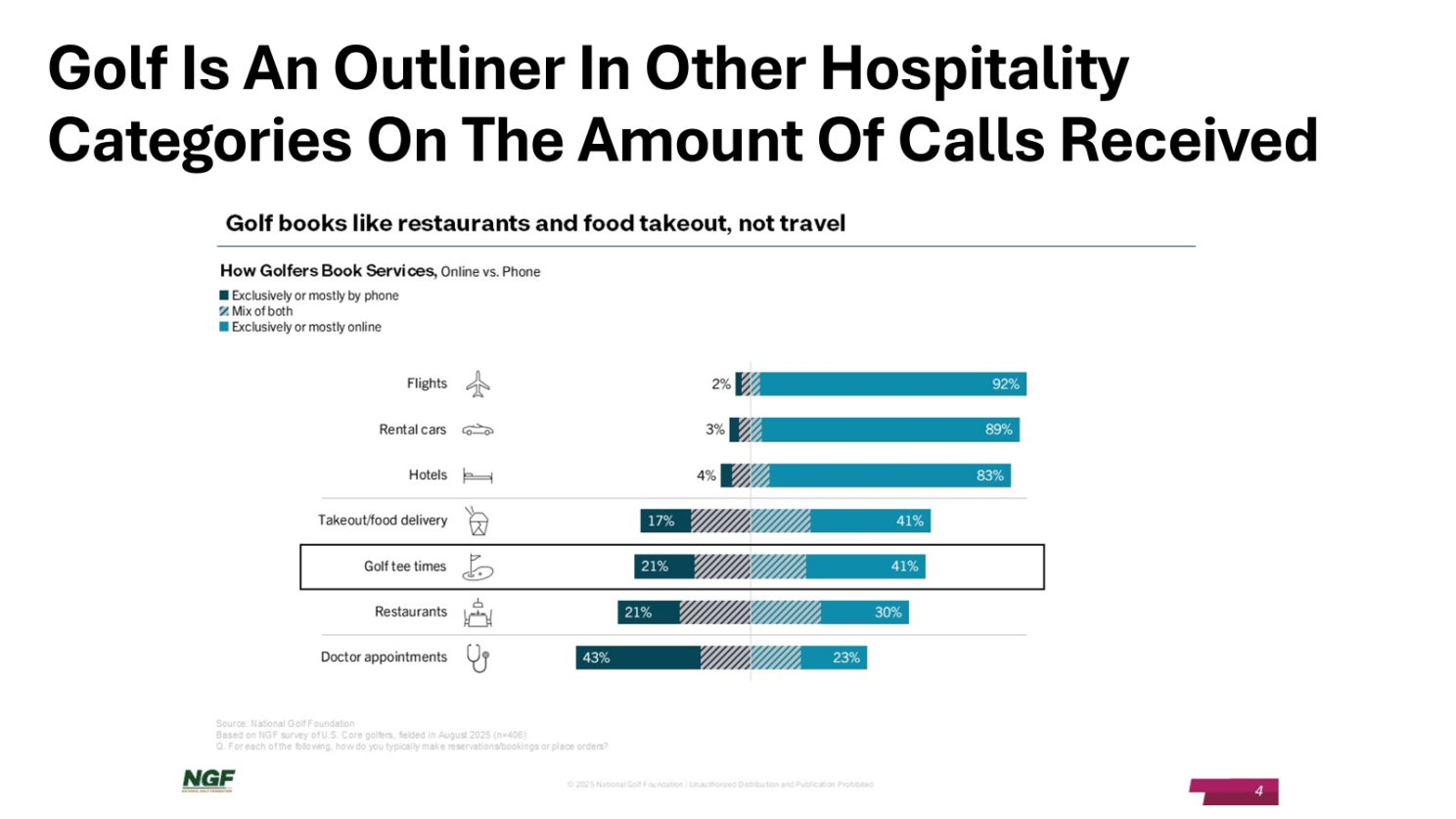
While golf is far behind other industries in direct online booking, it doesn't have to be with the record amount of demand by consumers.
For that reason - the future of booking golf is going to feel a lot like booking a flight, and it really comes down to four shifts happening together, plus one thread that runs underneath all of them.
Let's walk through them.
#1: Golfers will pre-pay when booking in the future
Air travel runs on prepay, and it has for generations. You buy the ticket today, you fly in June, and the airline takes your money the moment you book. That one habit is what makes the rest of the airline business work, and it is the shift golf has circled for years without quite committing to.
There is reason to believe golf will be the same.
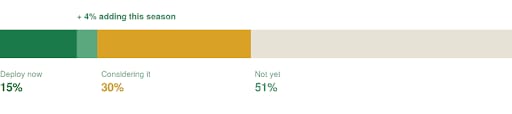
According to the 2026 NGCOA Golf Business Pulse Report (presented at MCOR26 by Jon Last at Sports & Leisure Research Group), nearly three out of four golfers say they are comfortable putting money down in advance. Two-thirds of owners think prepay is becoming a necessity. And yet only 15 percent of operators are doing it today.
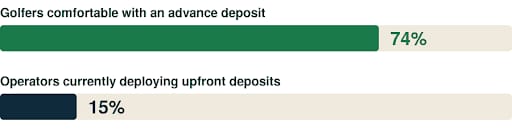
Here is the encouraging read on that chart. When three out of four customers tell you they will happily pay in advance, and two out of three operators agree they probably should be collecting that money, the thing holding golf back is not the golfer. It is the stuff behind the counter, and that is the most fixable kind of problem there is.
There is also another reason operators hesitate beyond the perceived friction to golfers. It is the bookkeeping headaches.
When you collect $80 today for a foursome teeing off three weeks out, you have not earned that money yet. Under the revenue recognition standard that governs the books, ASC 606, revenue counts when the service is delivered, which in golf means when the round is actually played. Until that Saturday arrives, the cash is not revenue. It is a liability, money you owe the golfer. And most golf tee sheets and point-of-sale systems were never built to carry that liability, because for decades golf did not need them to. The round and the payment always showed up at the same time.
Airlines sorted this out long ago.
When you prepay a ticket, the airline parks the cash as something called Air Traffic Liability, an IOU to fly you later. It sits on the balance sheet, sometimes for months. Then on the day you fly, the obligation is met, the liability flips into recognized revenue, and the books tie out neatly. The trigger is the day of service, not the day of sale. For a big carrier, that liability balance runs into the billions at any given moment, and the whole industry closes its books around it every quarter without blinking.
It is the job of the technology platform powering the booking to help with this revenue recognition challenge for golf course operators.
While prepay certainly requires a lot of change management, the data is showing that over 30% of golf courses and operators are actually considering it today, representing a strong emerging trend.
#2: Golfers will stop calling the pro shop to book, because the screen will finally be better than the call and courses will no longer accept those calls
The real reason calling United to book a flight feels silly is not that phones are old-fashioned. It is that the alternative of booking online got so easy nobody misses the phone. The traveler books at midnight in ninety seconds. The airline books a million seats a day with nobody on the line. The phone call was never the product. It was the friction.
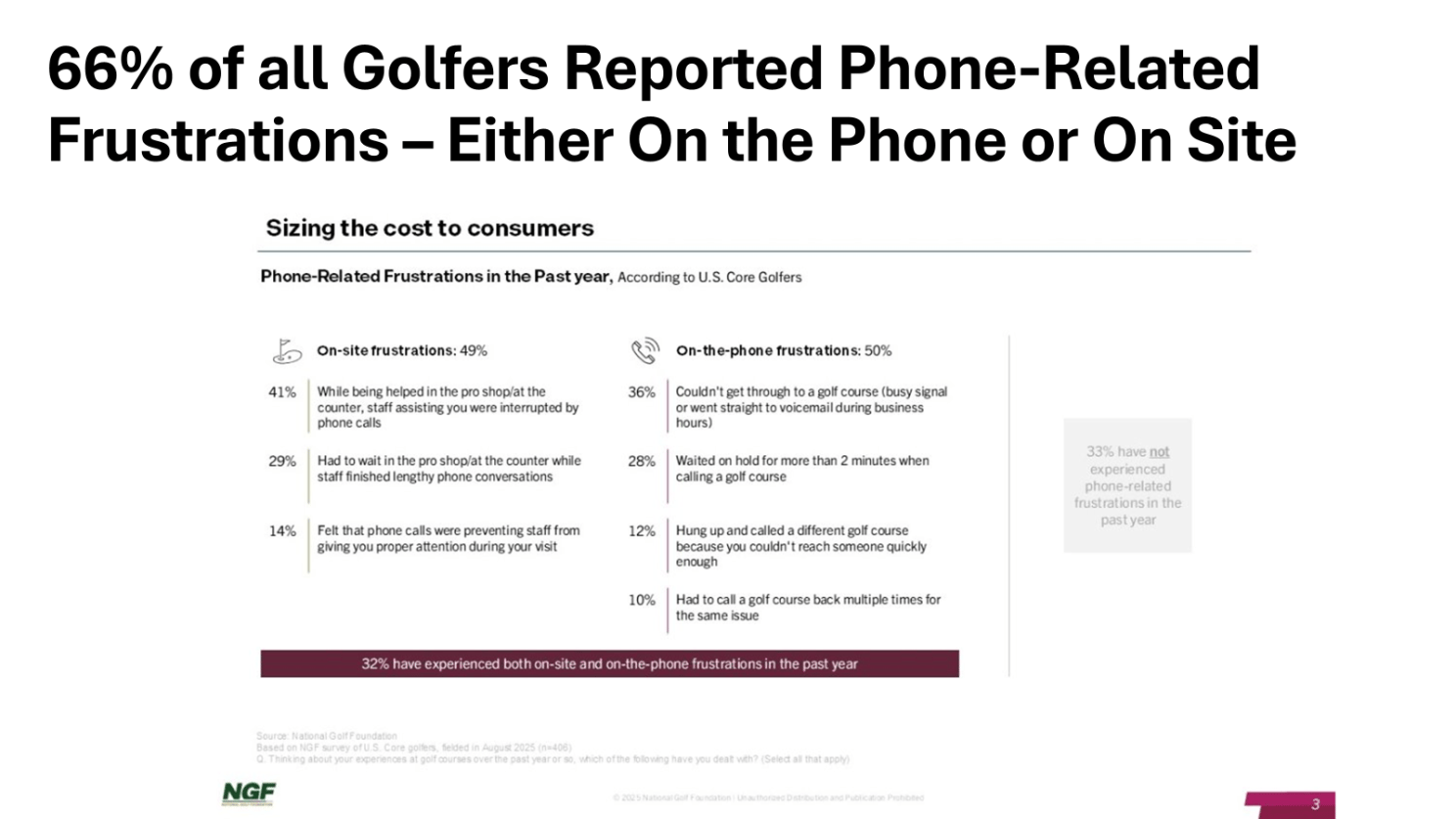
Golfers still have that booking friction and it shows up in the numbers. In Golf's $100 Million Phone Problem, the NGF estimates U.S. courses burned more than six million phone hours in a single year, worth over $100 million in staff time, fielding roughly 40 to 50 calls a day at the average facility. Two-thirds of those calls are about one thing: reservations and pricing. And 70 percent of operators already agree the phone eats staff time that belongs somewhere more valuable.
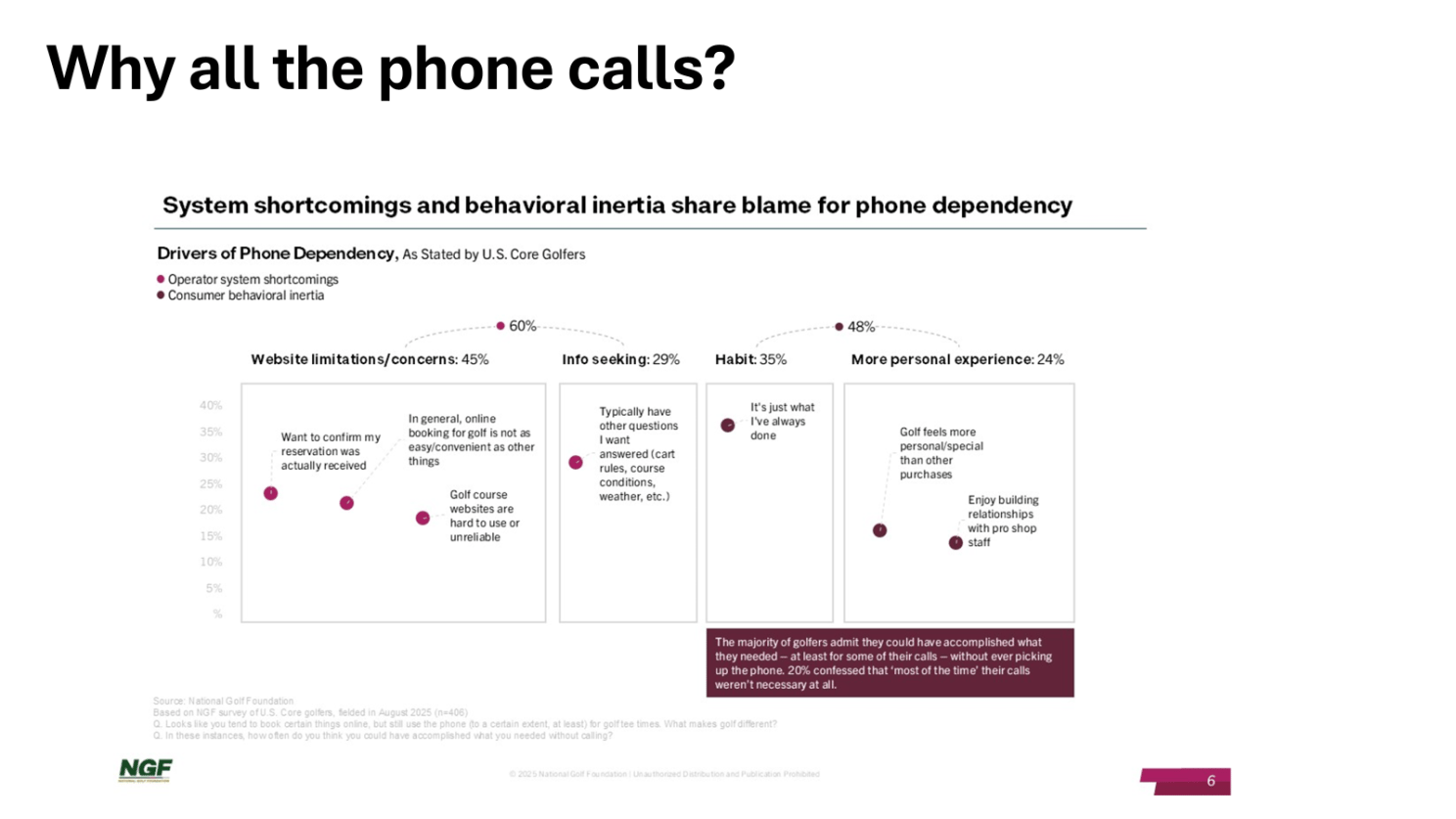
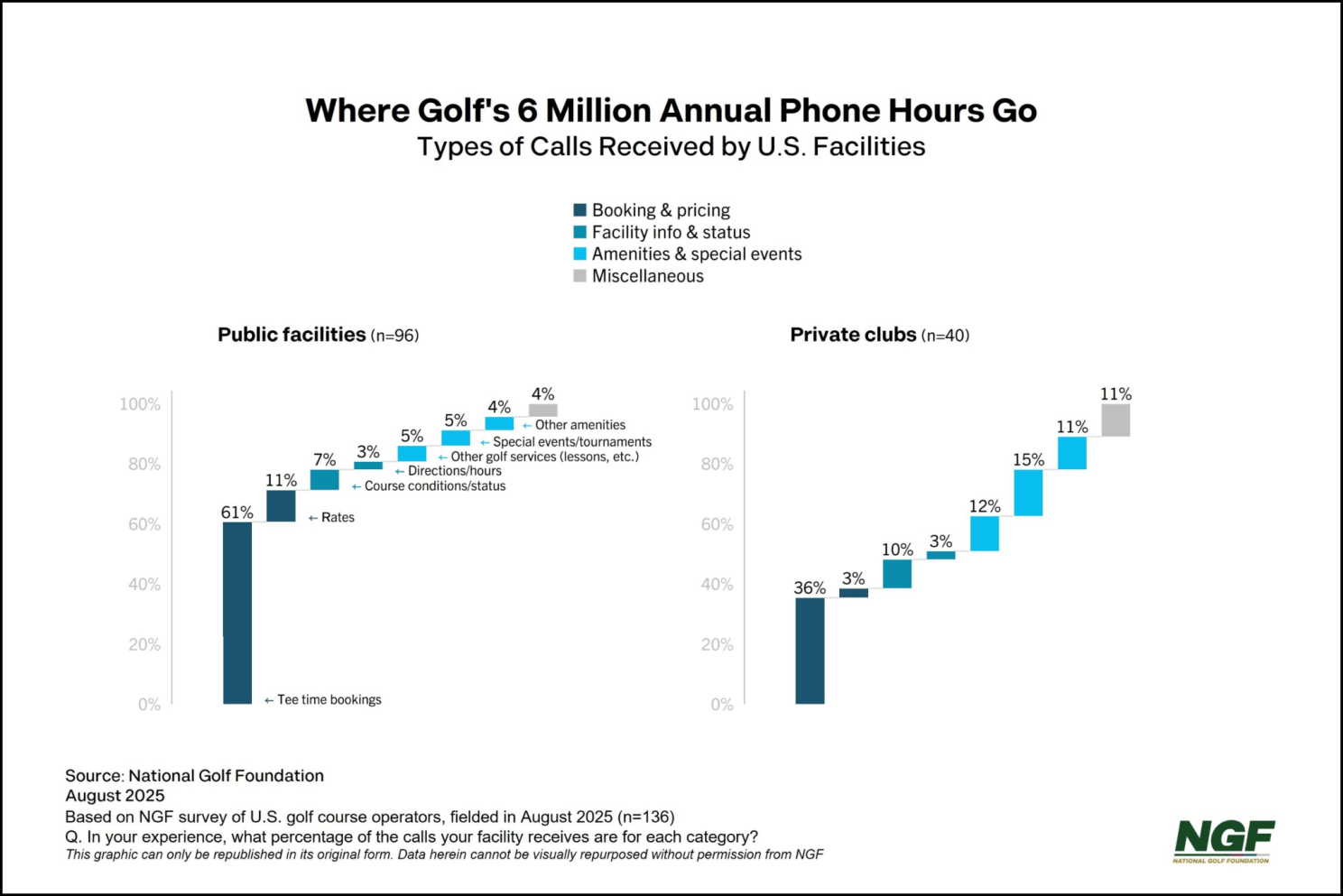
Here is the reframe worth sitting with. The fix is not an AI that answers the phone faster. The fix is a booking experience so good the call never needs to happen. The same NGF research found only about 40 percent of golfers book tee times mostly or entirely online, against 80 to 90 percent for flights, hotels, and rental cars. That gap is not about golfers being behind the times. It is about the software in front of them: nearly a third of golfers told the NGF that course websites and booking systems are hard to use, unreliable, or just less convenient than the apps they use for everything else. When the experience is worse, people reach for the phone. It is that simple, and that fixable.
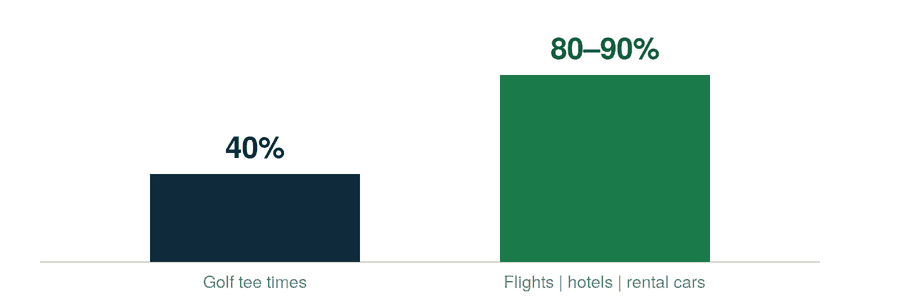
Most golfers admit a lot of their calls were not necessary, and the top reason for calling anyway was simply that it is what they have always done.
So the way off the phone is not a clever deflection trick. It is an online booking flow that beats the call on its own merits: live availability, clear pricing, a checkout that takes the deposit in seconds, and a mobile experience as obvious as the one a golfer already uses to book that Saturday flight. Build that, and golfers self-serve because it is plainly the better option, not because you nudged them. The phone quiets down on its own. And the cost of not building it is real: that same NGF study found more than one in ten golfers took their business elsewhere last year after a bad phone experience. In season, every call that rings out is a tee time someone down the road is glad to sell. There is a quieter cost as well: a phone call rarely leaves a trace. No profile, no email, no history. Online booking builds the customer record that every loyalty relationship is later made from, while the counter and the phone tend to erase it.
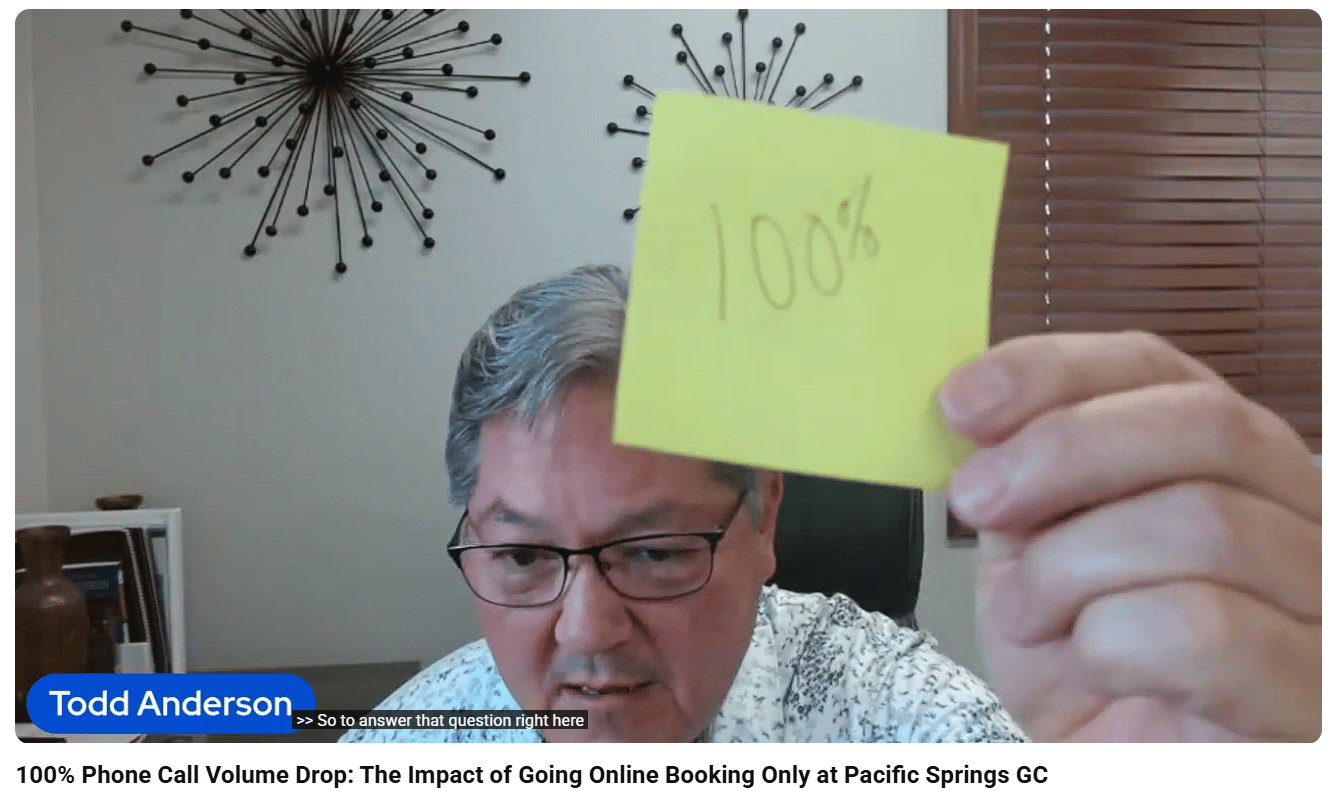
Case in point - Todd Anderson, General Manager at the popular public course Pacific Springs Golf Course in Omaha Nebraska - went to 100% online tee time booking only last season, despite doing 300+ rounds a day in the spring.
The payoff?
- Call volume all but disappeared (over 100% drop in calls)
- Data Base and Contact Information Accuracy Increased
- Revenue increased through more reliable bookings
- No-shows dropped thanks to strong accountability policies
- Staff stress plummeted
- Golfer experience improved because online booking is faster and more accurate, and more time could be given in person
#3: Operators will clearly define and enforce their cancellation policy
While airlines do pre-pay, they are actually often clear and communicative about their cancellation policy. Their technology and communication system does the enforcing so no human has to. A basic fare cannot be changed. A flexible fare can. Cancel a nonrefundable ticket and you usually do not lose everything; you get a credit to use later, often minus a fee, and it expires on a schedule. Each of those policies is generous enough that travelers book with confidence, and every one is enforced automatically by software, not negotiated at a counter.
Golf courses often have a policy. What often is lacking is the enforcement, and the gap is costing the industry a fortune.
An analysis from Metolius Golf and Noteefy, reported by Forbes and the NGF, studied more than ten million rounds across 500-plus courses - ultimately putting the public-course no-show rate at 9 percent in 2024 and the lost opportunity at around $1 billion a year.
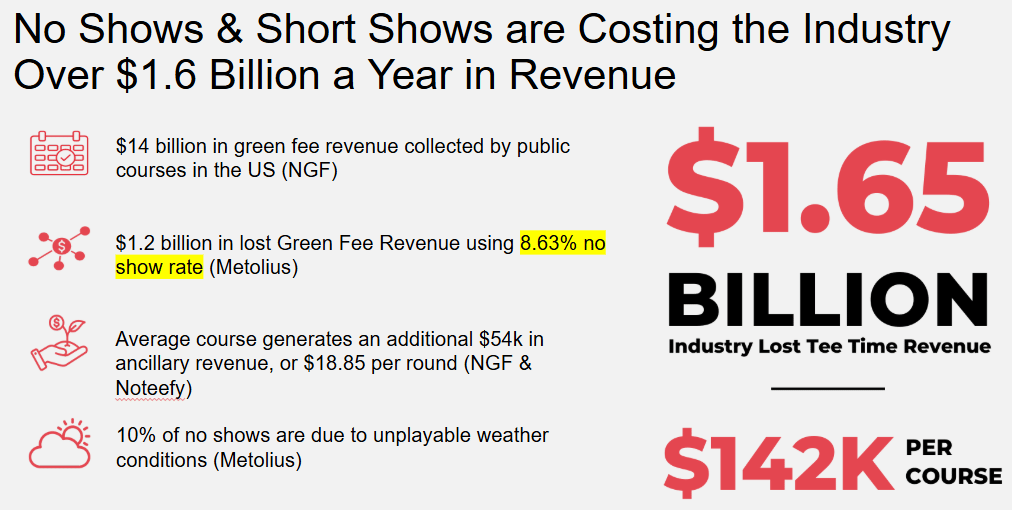
Similar to a flight - each no-show is rarely just a missed green fee. In its companion piece, Course Economics in the Experience Era, the NGF estimates total revenue per occupied tee time runs about 45 percent above the green fee alone once you count food, beverage, range balls, and merchandise. The slot that ghosts walks off with all of it.
Of abandoned rounds were not weather-related, so they were preventable (NGF)
That last figure is the hopeful one. The same NGF analysis found only about 11 percent of abandoned rounds came down to unplayable weather. The other 89 percent were not bad luck. They were the predictable result of frictionless cancellation with no consequence, which means they respond to two friendly levers: better technology and clearer policy. Ask for a card to book. Send automated reminders before the round. Run a waitlist that rebooks the slot the second it opens. Let the deposit forfeit on a true no-show, and turn the borderline case into a rain check rather than a write-off, the same way airlines turn a cancellation into a credit shell instead of a refund. None of this is heavy-handed. It is just clarity, applied consistently.
A cancellation policy that nobody enforces is not really a policy. It is a suggestion, and golfers learn fast that there is no cost to ghosting.
The goal is not to punish anyone. It is to make cancellation flexible and certain at the same time: a clear window for a free cancel, a partial credit after that, an enforced forfeit for a true no-show, all applied by the system the same way for every golfer, with no one behind the counter stuck playing referee. Flexibility is what gives golfers the confidence to book. Enforcement is what protects the revenue once they do. This is the same playbook OpenTable used to tame restaurant no-shows, and golf is now borrowing it more or less wholesale. And consistency does double duty: it builds trust, which is the quiet engine of loyalty. Golfers come back to the course that treats them fairly and predictably every single time, far more reliably than to the one with the flashiest punch card.
#4: Booking will be fast, clean, and increasingly conversational with AI assistance
The last thing that makes air travel so bookable is that the experience is just pleasant to use. Modern flight booking is fast, mobile, visual, and obvious. You see options, you compare, you pay, you are done. A fair amount of golf booking still looks like software from the era when the laptop in that conference slide was new: clunky flows, dead ends, and a screen demanding an account nobody wants to make.
Travel is seeing an influx of AI tools that make this easy.
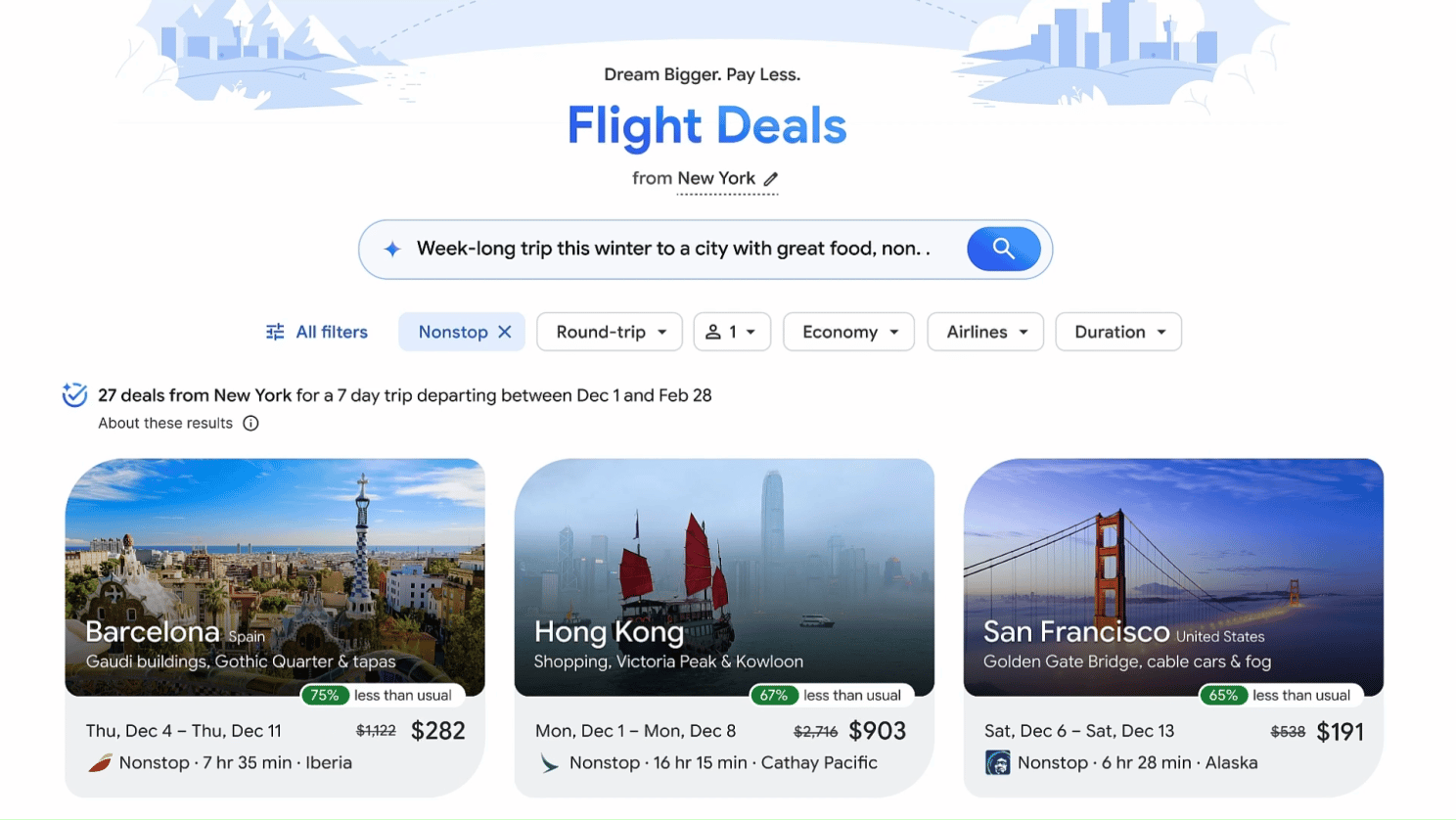
Google Flight Deals, for example, is designed for flexible travelers whose number one goal is saving money on their next trip. Instead of playing with different dates, destinations and filters to uncover the best deals, you can just describe when, where and how you’d like to travel, as though you’re talking to a friend, and Flight Deals will take care of the rest.
Google launches new AI-powered flight deals tool
The next step is already arriving, and it is conversational. Travelers now rebook a canceled flight, switch a seat, or ask for the cheapest morning option just by telling an AI assistant what they want.
Golf is heading the same direction, and the timing is wide open.
The NGF found fewer than a quarter of operators are even exploring automated or AI-driven tools, so there is real room to move early. An assistant that can answer the late-night availability question, find the open slot, take the deposit, and apply the cancellation rules turns the whole booking from a form into a conversation. It also gives the smallest pro shop the booking smarts of a major airline without adding a soul to payroll, and it frees the staff you already have for the on-property moments that actually build loyalty.
This is where loyalty gets personal: an assistant that remembers a golfer's favorite Saturday time and greets them by name does more for retention than any points card. The same AI cuts both ways, mind you, because it will just as happily show your regular a cheaper round down the road, which is precisely why the experience itself has to be worth coming back for.
And the demographics are on your side. The Pulse Report notes that comfort with prepay tracks with golfer age, and every cohort coming up grew up paying for everything in advance, on a phone, by tapping a clean screen or just asking an assistant. The 74 percent comfort number is not a ceiling. It is a floor, and it rises a little every year.
#5: Underneath all Four: Loyalty Embedded into Bookings
Here is the idea that ties the whole airline comparison together. Airlines did not fight for prepay, self-serve, enforced policies, and beautiful apps purely for efficiency. They did it because every one of those things is a loyalty machine, and the booking is where the relationship starts. Golf has the same opening, and arguably a better one, because a course full of regulars is already a loyalty business at heart. It just keeps handing the relationship back at the counter.
It helps to separate two ideas the industry tends to blur, a distinction Amadeus draws nicely in its look at airline loyalty schemes. There is loyalty, the human feeling of being understood, appreciated, and valued, and there is a loyalty scheme, the concrete machinery of points, tiers, and co-branded credit cards. Airlines run enormous schemes, and for the big U.S. carriers that loyalty revenue is a serious profit center. But the research is blunt that the scheme is not what earns the loyalty.
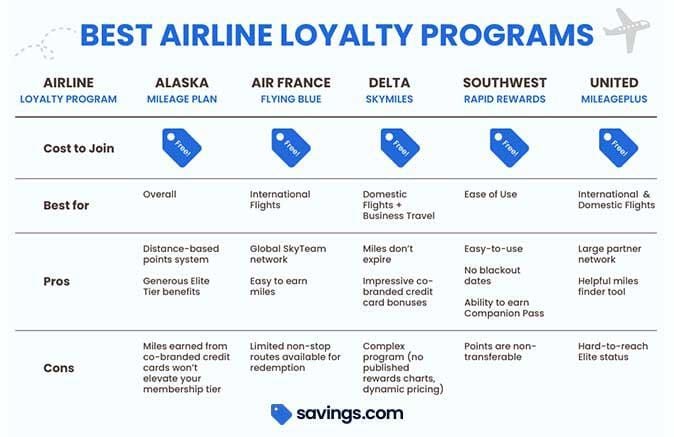
Loyalty runs on value, not points. The scheme is the scoreboard, not the game.
That is good news for golf, because it means you do not need to bolt on a clunky punch-card to win loyalty. You need the same things airlines win on: value, trust, service, and an experience worth returning for. And every one of the four shifts above builds exactly that. Prepay and online booking capture the golfer's identity, so you can finally recognize and reward a regular instead of greeting them like a stranger every visit.
Fair, enforced, transparent policies build the trust Amadeus places at the center of loyalty. A clean, increasingly personal booking experience is the value and the service, delivered every time someone reaches for their phone.
One fair caution from that same research: as AI assistants get better at surfacing the cheapest option anywhere, scheme-based loyalty gets shakier, since the assistant will gladly point your regular to a deal down the road. Which only sharpens the point. In a world where price is one tap away, the relationship and the experience are what keep a golfer coming back to you. Book like an airline, and you are not just filling a tee time. You are earning the next one.
Bringing it home: The runway is clear. Time for golf courses to take action!
Put the four together and the picture gets pretty clear. Golf booking is going to feel like booking a flight: you pay when you book, you skip the phone because the screen is finally the better option, you cancel inside rules the system actually enforces, and you do it all through an experience that is fast and increasingly conversational. And because every one of those moves quietly builds the relationship, the real payoff is the one airlines have chased for decades: loyalty. None of this is a leap of faith. It is the same path air travel walked decades ago, proven across trillions of dollars of commerce, and the data from the NGCOA and the NGF shows golfers and owners already waiting at the trailhead.
Sources are linked inline throughout: 2026 NGCOA Golf Business Pulse Report (Sports & Leisure Research Group, MCOR26); National Golf Foundation; Forbes / Metolius & Noteefy; Amadeus. Revenue recognition treatment described here is general and not accounting advice; check anything balance-sheet related with your own advisor.