In This Article
- You Already Have the Data, You Need the Insights
- The Best Comp: How Hotels Ran This Play First
- Three Moves That Define the Golf Data Revolution
- One System Tells You What Happened, A Connected Platform Shows You Why
- The Maturity Curve: Consolidate, Report, Automate
- The Operator Playbook: How to Capitalize
- The Window: Early-Mover Math
- Key Takeaways
- FAQ
What Is the Golf Data Revolution and What Does It Mean for Operators?
The golf data revolution is the shift from disconnected, export-dependent reporting to unified, weather-adjusted, AI-assisted performance intelligence, which is the same discipline that transformed hotel operations starting in the early 1990s. The average golf facility runs five or more disconnected systems. When those systems share a common data spine, operators can answer in seconds what currently takes hours of spreadsheet work: why rounds were down, where revenue is leaking, and what to do about it before the quarter is already over.
Hotels ran this exact play thirty years ago and it created an entire industry called revenue management. Golf is at that same inflection point right now. The operators who move first won't just outperform their competitors. They'll set the benchmarks everyone else gets measured against for the next decade.
You already have the data, you need the insights.
A golf course is a business that generates a mountain of data every single day.
This includes your tee sheet, POS, F&B, marketing efforts, CRM, and guest surveys. Then there’s the weather data layer. And almost none of it talks to each other.
Think of a simple question you may want to know: "how did we really do last month versus last year?" The routine to find that answer is instantly familiar: log in to each system, export a bunch of raw data files, stitch together a massive spreadsheet, and try to make some informed guesses.
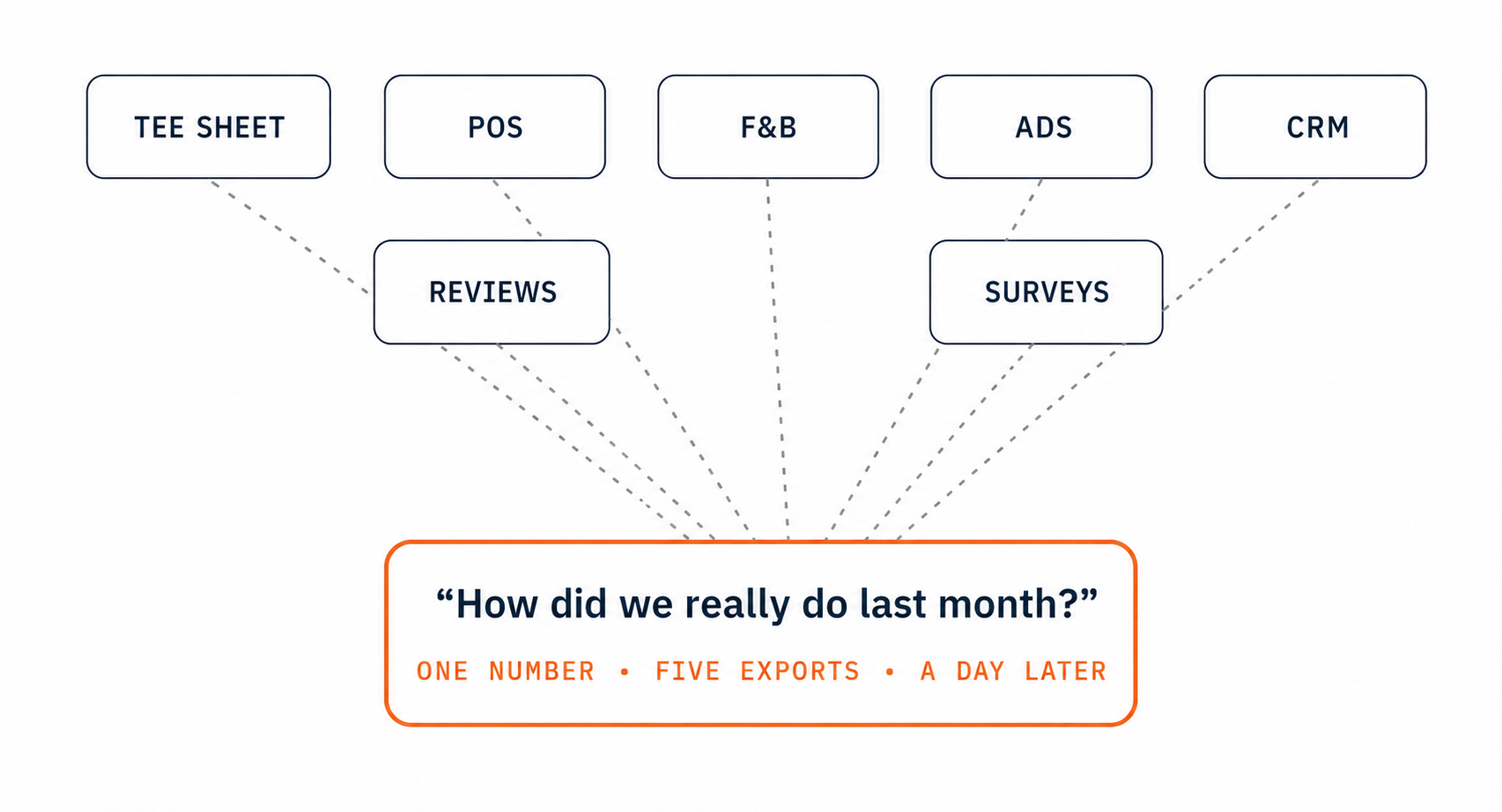
Most standard business tools haven’t helped. Generic Business Intelligence (BI) platforms are built for analysts, not General Managers. So the default routine remains what it’s been for twenty years: spreadsheets, gut feel, and finding out about a problem, rounds slipping, margin leaking, or a budget miss after the quarter is already over.
The argument has stayed the same for most of those twenty years: this industry is sitting on a goldmine of operational and customer data, and most facilities are barely scratching the surface of it.
Most operators know how many rounds each course sold last month. What remains hard is connecting that number to weather patterns, marketing campaigns, pricing changes, or customer segments, across a whole portfolio, without hours of manual spreadsheet work.
The data exists to answer every one of those questions, but it’s just not in a place where anyone can use it. As a result, facilities are managed reactively, waiting for month-end reports to reveal problems that were visible in the data three weeks earlier.
This isn’t a golf-specific problem, however. It’s a hospitality problem, and hospitality already solved it.
Hotels already ran this play, and it reshaped the industry.
In 1985, most hotel GMs managed their business the way most golf GMs do today: an occupancy report, a ledger, and instinct.
Then three things happened, roughly in sequence, and together created what the industry now just calls Revenue Management.
First, the airlines proved the model. After deregulation, carriers like American built yield management systems that priced every seat dynamically based on demand. The insight was simple, yet brutal: an empty seat at takeoff, much like an unused tee time, is revenue you can never get back. Perishable inventory demands data-driven pricing.
Second, hotels imported the model and standardized the language. Marriott famously built one of the first hotel revenue management operations and credited it with hundreds of millions of dollars in incremental annual revenue. At the same time, Smith Travel Research (now STR) began benchmarking hotel performance across the industry. Suddenly every hotel operator on earth spoke the same three words: Occupancy, ADR, and RevPAR.
Revenue per available room became the metric, the one number that captured both how full a property was and how well it was priced.
Third, the data layer became table stakes. Property management systems connected to channel managers, CRSs, and CRMs. Comparison sets meant every GM knew not just their RevPAR, but their RevPAR index against the five hotels down the street. Restaurants followed suit: OpenTable digitized the reservation book in the late 90s, and within a decade covers, seat utilization, and guest history went from paper to discipline.
And then the category matured into an industry of its own. IDeaS, the revenue science platform born out of the original yield management era, now sells performance dashboards whose entire pitch is the one golf operators will recognize instantly: ditch the spreadsheets, consolidate every property into one intuitive view, identify problem properties and segments at a glance, and slice performance by cluster, segment, and rate code.
Hotels using these tools forecast demand not 90 days out but two years out, and resort operators on the platform report RevPAR lifts averaging 22%. Executives describe the payoff in exactly the terms this piece is about: knowing where revenue actually comes from, where sales effort should concentrate, and when to time marketing initiatives. Three decades of data discipline compounds into an entire vendor category: revenue science as standard infrastructure.
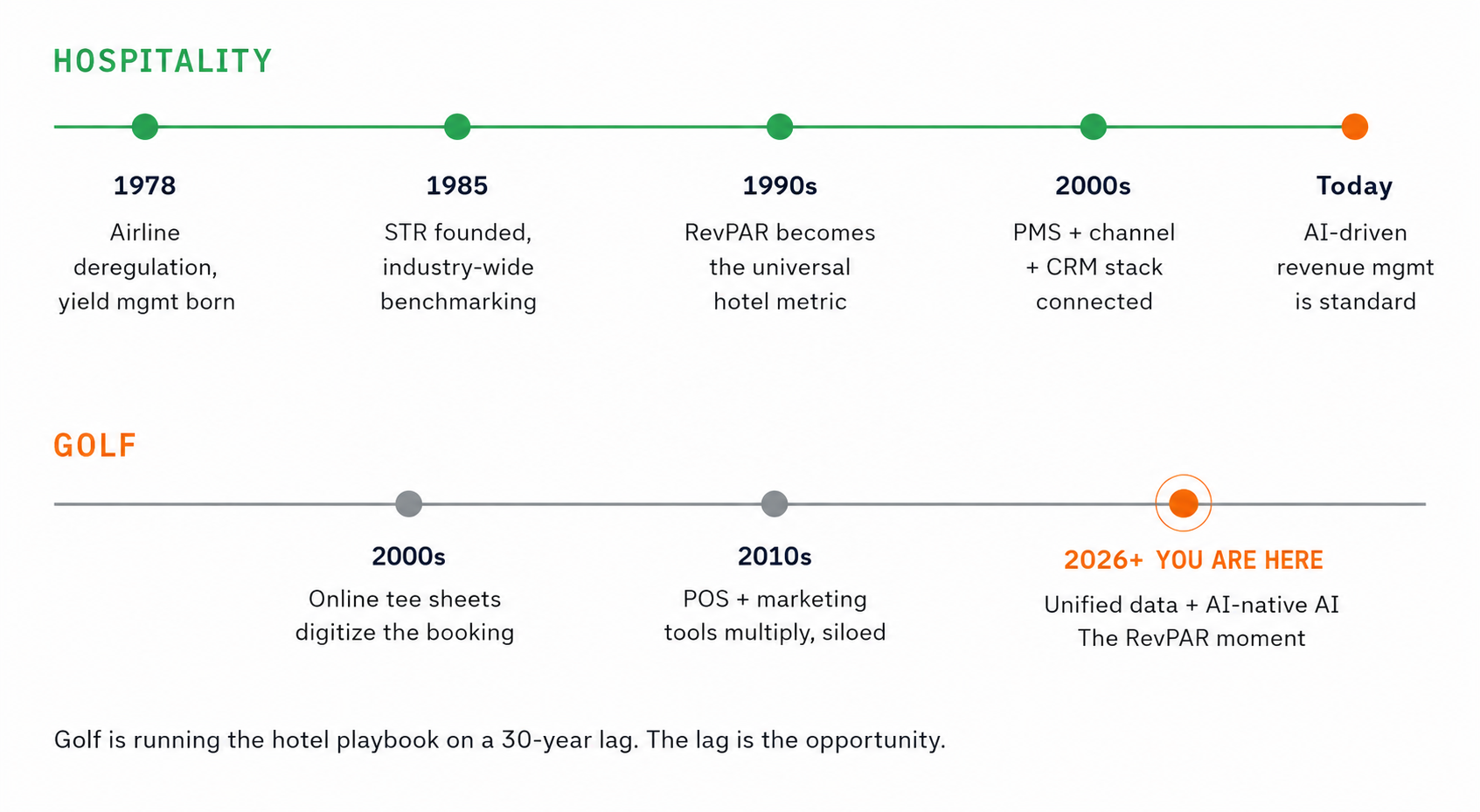
The result of that thirty-year arc: no hotel GM on the planet debates whether to yield-manage. Revenue management went from competitive advantage to job requirement, and the operators who adopted early compounded gains for a decade before laggards caught up.
Golf has the same perishable inventory as hotels. And yet golf, a roughly $100B+ ecosystem in the US counting course operations, travel, and retail, still largely runs on exported spreadsheets. The parallel is almost exact: Golf has occupancy (tee sheet utilization), ADR (rate per round), seasonality, dayparts, perishability, weather exposure, and ancillary spend (F&B, pro shop) that mirrors a hotel’s outlets. What golf hasn’t had is the connective tissue: the unified data model and the shared metric language that made hotel revenue management possible.
This is the revolution the golf industry is not undertaking.
Three moves that define the golf data revolution.
1. From five exports to one governed model
The foundation is unglamorous but it’s everything: every system conformed and reconciled onto one spine. Location, date, source. When POS, tee sheet, marketing, CRM, and guest feedback all tie back to the same property and the same day, "compare this June to last June across every course" stops being a data project and becomes one click.
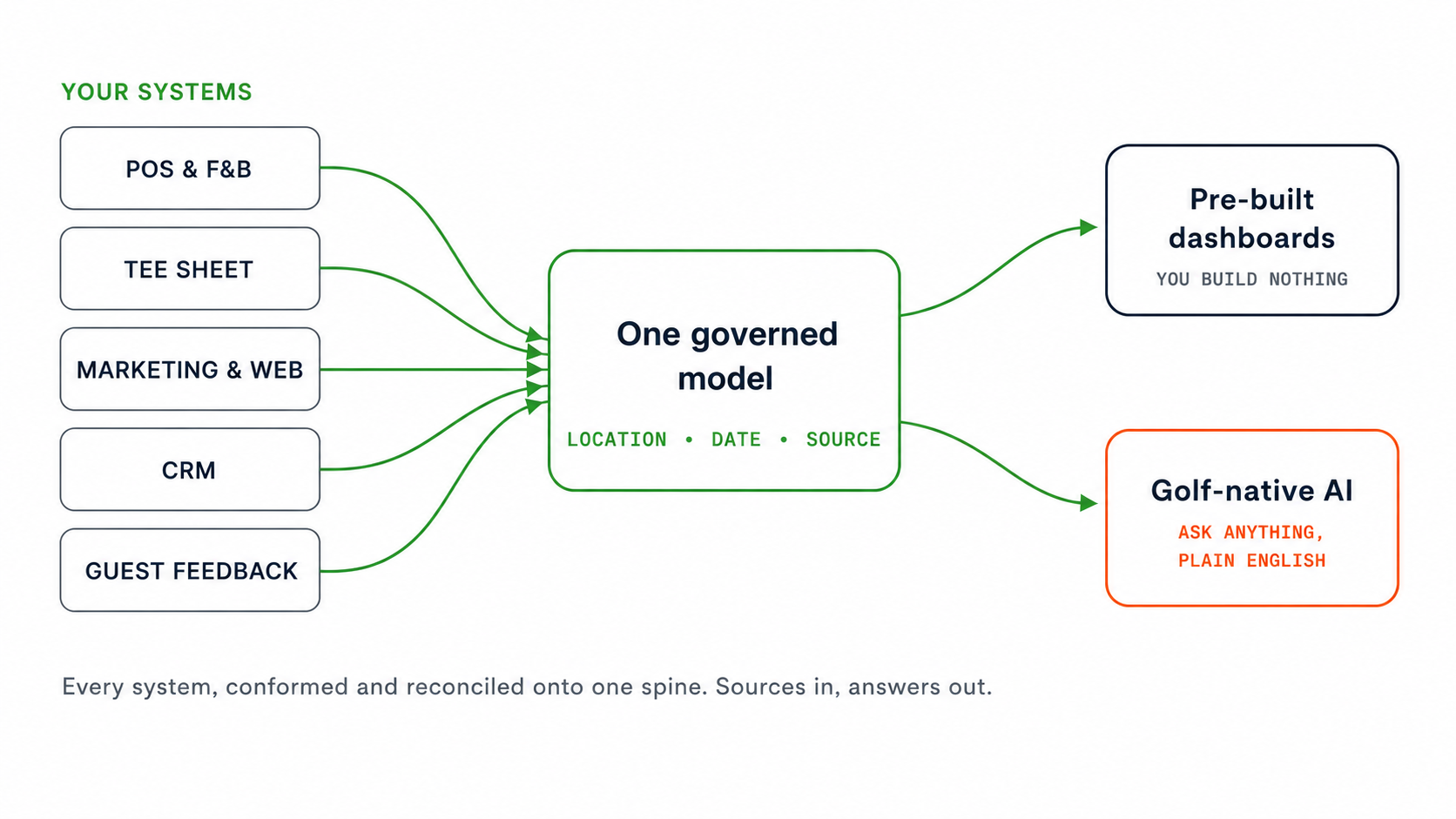
Governance is the word that matters. A governed model means every metric has one definition, reconciled to the books. Total sales means the same thing in the boardroom as it does in the pro shop. That’s what hotels got from standardized STR reporting.
2. From raw numbers to weather-adjusted truth
Hotels benchmark against a comp set. Golf’s most important comp isn’t the course down the street, it’s the weather.
Rounds were down 6% in June. Is that a demand problem, a pricing problem, or eleven fewer playable hours of daylight? Without weather-adjusted capacity, there is no way to know. With it, the story often inverts entirely:

This is also where golf finally gets its RevPAR. Revenue Per Available Round does for a tee sheet exactly what Revenue Per Available Room did for hotels: it fuses utilization and rate into one honest number. Add utilization by hour and daypart, lost revenue from no-shows and cancellations, and cart attach rate, and a GM suddenly has the same yield-management toolkit a hotel revenue manager has had since the 90s.
RevPAR: Revenue per available round: golf’s version of the metric that reorganized the hotel industry.
WAC: Weather-adjusted capacity; how much of the playable time was actually captured?
Lost Dollars: No-shows and cancellations, quantified by daypart. Perishable inventory measured.
3. From reports to insights
Hotels needed trained revenue managers to interpret the data. Golf gets to skip that step, because the AI layer arrived at exactly the right moment.
Where the hype goes wrong is when most people hear "AI in golf," they picture consumer-facing gadgets: chatbots, virtual caddies, swing analysis.
The case made by Ross LIggett in Golf Inc.’s 2026 operations outlook points the opposite way: AI’s most meaningful impact for operators will be operational, not experiential. The unglamorous, enormously valuable motions: reconciling transactions across systems, generating commission reports that eat hours of manual work, building staffing models from historical patterns and forecasted demand, or Tagging customer behavior to spot trends before they show up in revenue.
The honest estimate: automation can return 10 to 20 hours per week of management time, but only when it’s implemented intentionally. The value isn’t in the AI itself, it is in deploying it on clean, governed data.
This is an important distinction: a generic AI chatbot bolted onto operational data will confidently make up numbers. What actually works is an AI grounded in the governed model; one that answers only from real, defined metrics and cannot invent a figure. One that’s been taught golf’s vocabulary, so "cart attach" and "twilight yield" mean what operators mean. One that gives a head pro one number and one next step, and gives an analyst full depth. When a GM asks "why were rounds down in June?" the answer should read like the verdict card above: cause, context, and a recommended move. In seconds, not in next Tuesday’s meeting.
One system tells you what happened, a connected platform shows you why
The value isn’t in any single dashboard, it’s in the crossovers. Insights that only exist when systems share a spine.

Each one crosses at least two systems, and each one ends in an action, not a chart. Hotels connect ad spend to bookings to on-property spend, adjust expectations for market conditions, and treat guest satisfaction scores as an early warning on future occupancy. Golf can now do all of it, without hiring a single analyst.
The Maturity Curve:
Consolidate → Report →Automate
If the crossovers are the payoff, the path to them is a ladder: data consolidation first, reporting second, automation third. Each layer compounds the return on the one below it.

The top rung is where hospitality is heading and golf should follow: data that doesn’t just inform decisions but executes them. Triggered emails based on actual customer behavior, pricing that adjusts to demand signals, and outreach that fires without anyone touching it.
This is also what unlocks the shift that matters most in 2026: personalization. For years, golf marketing has been broad strokes: the same email to every member and the same offer to every golfer.
Golf’s version is the same move: use behavioral data to tailor outreach to how each golfer actually interacts with the facility, such as how they play and when, to what they buy in the shop. For private clubs, that means continuous data-informed engagement instead of the traditional annual member survey. For public courses, it means converting one-time green fee players into loyal customers through targeted follow-up.
How to capitalize on this opportunity
Get everything on one spine
Consolidate POS, tee sheet, marketing, CRM, and feedback onto one governed model tied to location, date, and source. Until every number reconciles, management runs on anecdote. This is the non-negotiable first step, just as the Property Management System was for hotels.
Adopt hotel-grade metrics
RevPAR (revenue per available round), utilization by hour and daypart, budget pace by GL account, lost revenue from no-shows. Make them the vocabulary of the weekly meeting. This turns GMs into Revenue Managers.
Weather-adjust everything
Grade teams on capture of playable hours instead of raw rounds. It’s the only way to separate demand problems from weather noise, and it’s the fairest way to evaluate a season, a manager, or a marketing campaign.
Manage leading indicators
Revenue tells you what already happened. NPS, pace of play, and course-condition scores tell you what’s about to happen. When pace scores slip, rounds follow. Surface detractors while there is still time to save them.
Tie marketing spend to rounds
Connect spend to sessions to bookings to green fees and F&B. Cut what doesn’t fill the tee sheet and invest in what does. Marketing budgets defended with evidence of return survive budget season, not budgets defended with impressions.
Personalize the outreach
Retire the one-size-fits-all email blast. Segment by behavior to begin: what golfers play, when they play, what they spend.
Automate the busywork, and make the numbers come to you
Imagine a world where reconciliation, commission reports, staffing models, and board packs email themselves on Monday at 7am, or a platform that alerts you when revenue falls below budget pace. This is where the 10 to 20 hours of weekly management time come back, and where reactive management finally becomes proactive.
The early-mover math favors whoever moves first.
The uncomfortable truth from the hotel era is that revenue management didn’t lift all boats equally. It transferred share from operators who guessed to operators who knew.
When one hotel in a market prices dynamically and its neighbors don’t, the dynamic pricer wins the high-demand nights at premium rates and backfills the soft nights with smart discounts. The neighbors get whatever demand is left, at whatever rate they set in January.
Golf is at the front of that same curve. Today, a course running weather-adjusted yield management against competitors pricing off gut feel has an advantage that is structural, not incremental. For every Saturday morning priced correctly, every no-show recaptured, or every detractor called back, share moves. The average hotel revenue manager is working from a two-year demand forecast while the average golf GM is still reconstructing last month from five exports. That gap is the opportunity. And for multi-course operators specifically, the math compounds: a discipline proven at one property rolls out across the entire portfolio.
In hotels, the operators who treated data as a competitive weapon in 1995 spent the next decade taking share from the ones who treated it as an IT expense. Golf’s 1995 is now.
The technologies driving this are not new: the integrated POS and tee sheet platforms, AI-driven reporting and forecasting, and automated marketing. What changed is the expectation: it's no longer a nice-to-have , it's essential infrastructure. The operators who haven’t adopted them are falling behind not because the technology is revolutionary, but because their competitors are using it to make faster, better-informed decisions. And the gap between data-driven facilities and everyone else is only going to widen.
The good news: unlike hotels, golf doesn’t have to spend fifteen years building this discipline from scratch. The playbook is written, the metrics are proven, and the technology, unified data models with golf-native AI on top, has finally caught up to the ambition. What took hotels a generation is available to a golf operator this season.
The data revolution in golf isn’t coming. It’s here. The only question left is the same one those hotel GMs faced thirty years ago: who will set the benchmarks, and who will spend the next decade being measured against them?