Is golf's growth slowing in 2026?
Signs point to a plateau. NGF data shows rounds grew in 63 of the last 66 months, but in the Noteefy 2026 Operator Survey nearly 50% of operators described their season as flat or down, including 68% of public and municipal courses. With rate increases nearing their ceiling and the pandemic, LIV Golf, and YouTube golf tailwinds fading, retaining existing golfers is the most cost-effective path to continued growth.
Golf has been on a run few other categories can claim. According to NGF data shared on Noteefy's recent webinar with Lightspeed and Ron Jaworski Golf, 63 of the last 66 months have shown rounds growth, and course financial health is the strongest it's been in over a decade. Adjusted for weather, revenue and rounds are running 13% better in 2025 than they were in 2020.
This year, operators themselves are seeing signs of softening when it comes to rounds played: nearly 50% describe their season as flat or down, according to the Noteefy 2026 Operator Survey. Public and municipal courses are feeling it the most, with 68% flat or down.
We're Bumping Our Head on the Ceiling
Over the last few seasons, rate has done a lot of the heavy lifting in maintaining revenue growth. Ross Liggett, VP of Data at Noteefy, pointed out that a 5.1% rate increase produced 2.4% more revenue per tee time over the last two years, closing a gap operators couldn't during the downturn from 2012 to 2019. "We are approaching this sort of place of equilibrium," Ross said, "where we now are actually using our rate to impact supply and demand and try to drive people to different areas of the tee sheet." Rate, however, can only climb so far.
The Record Growth Was Borrowed
Ross was direct about where the last several years of momentum actually came from: "If you look at what happened over the course of COVID, and the boom that followed, largely, we were the beneficiary of external forces that brought people to the game."
During the pandemic, golf got a rare wave of good press as one of the few activities people could safely do. Then came the LIV Golf and PGA Tour feud, YouTube golf creators with massive cult followings, and mainstream hits like Netflix's Full Swing and Happy Gilmore 2.
Jake Gordon, Co-Founder and CEO at Noteefy, has made this connection before, citing YouTube golf content and celebrity exposure from the likes of LeBron James and Steph Curry as a genuine driver of new golfers entering the game.
"What we're seeing right now is that start to taper off. If we look towards external forces to create that demand, we're gonna go right back to where we were in 2011," said Ross.
How Do Operators Keep the Bull Run Going?
In short: retention.
Golf won't get another pandemic-sized push, and the creator wave has already crested. Chasing a new acquisition channel isn't the answer; keeping and maximizing the potential of the demand you already have is the unlock.
As Ross put it: "If we don't maintain all those golfers that we got for free, we're gonna have to start paying $500, $600, $1,000 in our marketing budget per golfer acquisition. Why would we want to do that when we could do it for free now?"
That reframes the plateau the data is beginning to reveal. With rate close to its ceiling and external tailwinds fading, what's left is what operators already have: the golfers who found their course during the boom. Now it's up to your course, staff, and experience to keep those golfers coming back and actually converting the demand you already captured.
The next phase of golf's growth will be driven by what operators do with the golfers they've already earned.

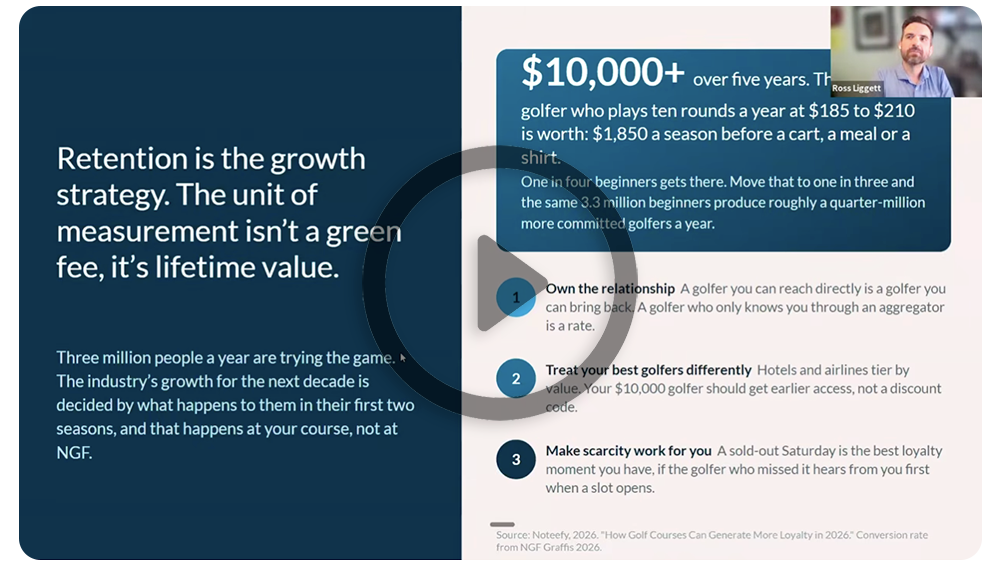
Watch the full conversation.
Noteefy, Lightspeed, and Ron Jaworski Golf on what comes after golf's historic run, from retention to protecting perishable tee-sheet inventory.